Baseball Roundtable March/April Wrap Up … Homers, Strikeouts and Streaks, Oh My!

It’s May 1, and that means it’s time for Baseball Roundtable’s March/April Wrap up – a look at the stats and stories that caught The Roundtable’s attention over the past month (in this case a bit more than a month), as well as The Roundtable’s Players and Pitchers of the Month, Trot Index and more.  As you might expect, given the state of the game, the highlights include a lot of home runs and a heavy dose of strikeouts.  Just a few of this month’s highlights that you will find in this post:

  • a player (Ildemaro Vargas) who collected a hit in every one of the 23 March/April games he played;
  • A pitching staff (Brewers) who fanned a record 20 opposing hitters on Opening Day;
  • 2026’s first Immaculate Inning (Mike Soroka);
  • One player (Jo Adell) making three homer-robbing catches in a single game, earning his glove a trip to Cooperstown;
  • Kenley Jansen climbing to number-three on the all-time saves list;
  • A player (JJ Wetherholt) being hit by a pitch in five straight games;
  • A manager (Alex Cora) fired after a 17-1 win;;
  • A hot line drive hit, literally, into a pitcher’s (Logan Gilbert) shirt; and
  • Much more.

Go the highlights and statistics sections section for all the stories.

Baseball Roundtable March/April Players and Pitchers  of the Month

NATIONAL LEAGUE

Player of the Month … Drake Baldwin, C, Braves

Drake Baldwin, the Braves’ 25-year-old C/DH, in just his second MLB season, has opened some eyes in Atlanta and around MLB. Baldwin put up a .308-7-25 line in March/April and also tied for the NL lead in runs scored (30) and for the lead in base hits (40). He was, in fact, one of only three MLB players with 25 or more run scored and 25 or more RBI for March/April.  A “25-25” start to the season is quite an accomplishment. In fact, if you lower the bar to 20+ runs and 20+ RBI, you still find only 16 2026 qualifiers.

Baldwin, in fact, scored in 24 of 20 March/April games and had two four-RBI contests. He collected hits in 25 March/April games and had multiple in 13. Baldwin, in fact, never went two consecutive games without a hit.

Baldwin was a third-round pick in the 2022 MLB Draft, out of Missouri State University, where he hit .317-24-105 in three seasons (120 games). In three minor-league seasons, he went .272-32-158 in 257 games and, in 2025, he hit .274-19-80 in 124 games for the Braves.

Honorable Mentions: Reds’ 22-year-old 1B Sal Stewart (like Baldwin in his MLB second season) got out the blocks fast, with a .281-9-29, line (with 20 runs scored).  His 29 RBI led MLB. Reds’ SS Elly De La Cruz cruised in at .282-10-24, with 26 runs and the added bonus of eight steals. Miami C Liam Hicks put up a .315-7-28 line  (second only to Stewart in RBI) and Braves’ veteran 1B Matt Olson went .296-9-28, with 27 runs scored. Finally, there is Diamondbacks’ 1B Ildemaro Vargas, who went .378-6-20 in 23 games (his .378 average leading all players with at least 75 at bats.) Vargas, notably, had at least one hit in every March/April game he played. More on Vargas in the Surprise Player of the Month section.


Pitcher of the Month … Shohei Ohtani, RHP, Dodgers

This was a tough one.  You had the likes of the Braves’ Chris Sale and Giant’s Landen Roupp, each with an NL-topping five March/April wins, the Brewers’ Jacob Misiorowski with a NL-leading 51 strikeouts in just 32  2/3 innings; the Dodgers’ Shohei Ohtani with an MLB-lowest (among pitchers with at least 25 March/April innings) 0.60 earned run average; and the Padres’ Mason Miller with an MLB-topping  ten saves (in ten opportunities) and 29 punchouts in 15 1/3 innings.

Wow! Where to go with this one.?  I went with Ohtani.

Consider, while Ohtani was only 2-1, you can’t ignore his MLB-best (among pitchers with at least 25 innings pitched) 0.60 earned run average. The guy gave up just two runs in five starts (30 innings) and he fanned 34 batters (nine walks). His 0.87 WHIP was fourth in the NL (among pitchers with at least 25 innings) and his .160 average against third.  As far as the lack of wins, you can’t blame Ohtani. In  his five starts, the Dodgers plated just six runs while he was in the game. (I gave him extra credit for pitching under pressure.)

The fact is, you can make a strong case for any of the Honorable Mentions as well.

Honorable Mentions: Already mentioned these near misses in the first paragraph: the Padres’ Mason Miller, who could easily have been part of a three-way tie (1-0, 1.17 with ten saves in ten opportunities and 29 strikeouts versus just three walks, in 15 1/3 innings); Giants’ Landen Roupp (5-1, 2.55 in six starts); Dodgers’ Jason Wrobleski, a surprise 4-0, 1.50 in five appearances/four starts;  and Braves’ veteran Chris Sale, 5-1, 2.31 in six starts, who gave up more than one run in only one of his six outings and who fanned 38 batters and walked just nine (35 innings).

AMERICAN LEAGUE

Pitcher of the Month – Jose Soriano, RHP, Angels

Photo: Sewageboy, CC BY-SA 4.0 <https://creativecommons.org/licenses/by-sa/4.0>, via Wikimedia Commons

This was a bit easier the the NL considerations. Earned Run Average is that bright and  shiny thing that always gets The Roundtable’s attention.  Couple it with victories and you have a Pitcher of the Month formula. Angels’ righty Jose Soriano’s March/April performance fit that twin bill.  Soriano put up a 5-1  in seven March/April starts – tying for the most wins in MLB.   And, his stingy  0.84 ERA was lowest among AL pitchers with at least 25 innings pitched (second only to Shohei Ohtani in MLB.).  In 42 2/3 innings (fifth-most in the AL), he gave up just 24 hits and 16 walks, while fanning 49 batters (tied for second-best in the AL).  Among pitchers with at least 25 innings pitched, His WHIP of 0.94 was fifth-best in the AL and he held batters to a .164 average (second-lowest among AL pitchers with at least 25 innings pitched). The 27-year-old’s emergence is a bit of a surprise.  In three previous MLB seasons (91 appearances/51 starts), he had been 17-21, 3.89.

In his seven starts this season, Soriano has given up zero earned runs in five.  His best game came on April 6 versus the tough Atlanta Braves, as Soriano went eight innings, giving up three hits and no runs, while fanning ten and walking none.  (Extra credit here, in that he went 5-1 for a Angels’ squad that went 12-20.)

Soriano is also a “good story,”  given the  challenges he has faced in his pro career. He was signed as an International Free Agent, out of the Dominican Republic, in March of 2016.  After showing some promise, but not rising above A-Ball, he underwent Tommy John Surgery in February of 2020 and was later taken (from the Angels) by the Pirates in the 2020 Rule Five Draft. In the Pirates’ system, he pitched just two games (High-A) before suffering another injury and undergoing his second Tommy John Surgery (June of 2021). In November of 2021, he was returned to the Angels and, after a rehab period, resumed his career at Single-A. Shortening up a long story,  Soriano showed swing-and-miss stuff and was promoted to the Angels  – as a reliever – in June of 2023 (3.64 ERA and 56K in 42 innings in 38 appearances for the Halos).  He was back in a starting role with the Angels in 2024 and was 6-7, 3.42 (22 games/20 starts/97K in 113 innings) before being put on the 60-day IL in early September.  He had a less eventful 2025, going 10-11, 4.26 in 31 starts (152K in 158 innings).  And that brings us to his remarkable 2026 early-season performance

Honorable Mentions:  Gotta like Yankees‘ 25-year-old righty Cam Schlittler, 4-1, 1.51 (ERA second only to Soriano among AL pitchers with 25 innings).  In seven  starts, he fanned 49 and walked just six in 41 2/3 innings. His  0.74 WHIP is the lowest among AL pitchers with at least 25 March/April innings and he held hitters to a .168 average. A shoutout also goes to Peter Messick of the Guardians, 3-0, 1.73 with 38K in 36 1/3 innings; the Guardians’ Gavin Williams (5-1, 2.70 in seven starts, with a league-leading 53 strikeouts; and the Yankees’ Max Fried, 4-1, 2.09 in seven starts, with a league-topping 47 1/3 innings pitched (0.80 WHIP, .161 average against).

Player of the Month… Yordan Alvarez, DH, Astros

Flickr user thatlostdog–, CC BY 2.0 <https://creativecommons.org/licenses/by/2.0>, via Wikimedia Commons

It’s rare that the Roundtable picks a primary DH as Player of the Month, but the Astros’ Yordan Alvarez earned it with a truly a dominant March/April at the plate. Alvarez had the second-highest batting average among MLB players with at least 25 March/April at bats at .356.  He led MLB in hits (42); was tied for first  in home runs (12); was fourth in RBI (27); and scored 25 runs. Alvarez led all MLB players with at least 75 at bats in slugging percentage (.737) and was first in on-base percentage (.462). Alvarez drew 21 walks (versus just 14 strikeouts. His month included  a 13-game hitting streak (April 14-28), during which he hit .389-5-12. Overall,  he collected hits in 25 of 31 games; and multiple hits in 14.

Honorable Mentions: Diamondbacks’ Ildemaro Vargas, a lot more on Vargas in the Surprise Player of the Month section.  Suffice here to just to say he posted  .378-6-20 line, with a 23-game hitting streak. Vargas was edged out by Alvarez due the latter’s HR, RBI and runs scored advantage. Also recognized zed are Yankee 1B Ben Rice, who went .327-10-23, with 26 runs scored; and the Angels’ Mike Trout, who hit just .248, but drew 32 walks (.431 OBP), smacked  ten homers, drove in 21 runs and scored an 29.


Surprise Player of the Month … Ildemaro Vargas, 2B/3B/SS, Diamondbacks

This one should be subtitled “For The Love Of The Game.

Ildemaro Vargas is a true journeyman, utility player, in his first nine MLB seasons 2017-25 … Diamondback, Nationals, Cubs, Twins , Pirates), he appeared in 174 games at 3B, 145 at 2B, 48 at SS, 29 in LF, five on the mound and two in RF; plus 104 games as a pinch-hitter, 14 as a pinch-runner and seven as a DH. In 2021 alone, he took the field for the Cubs, Pirates and Diamondbacks.

In those first nine MLB seasons, he appeared in an average of 51 MLB games per season, never reaching 100 games.  (In seven of those nine, he also spent time in the minors). Over those nine seasons, Vargas hit .249-20-145 over 458 games.  Side Note:  Vargas also has a dozen seasons in the Venezuelan Winter League on his baseball resume.

This season, Vargas is off to a .378-6-20 start (with his average leading all MLB qualifiers).

Further, he has yet to go a game without a hit.  Let me key that again, he has played 23 games in March/April and  has at least one hit in each of them.  He also collected hits in his last three games of 2025, giving him an active 26-game hitting streak. And, true to his history, this season, he has appeared at 1B, 2B, 3B,SS,  LF and DH. DH

This is a true surprise and a great feel-good story. (Oh, for those who like to know such things, the longest season-opening hitting streak belongs to the Tigers Ron LeFlore at 30 (1976).

__________________________

THE TROT INDEX … A REGULAR BASEBALL ROUNDTABLE FEATURE

Through April 30,  35.8% of the MLB season’s 35,655 plate appearances ended in a trot (back to the dugout, around the bases, to first base). We’re talking about strikeouts, home runs, walks, hit by pitch and catcher’s interference – all outcomes that are, basically, devoid of action on the base paths or in the field. Here’s the breakout: strikeouts (22.2%); walks (9.6%); HR (2.8%); HBP (1.1%); catcher’s interference (less than 1%). 

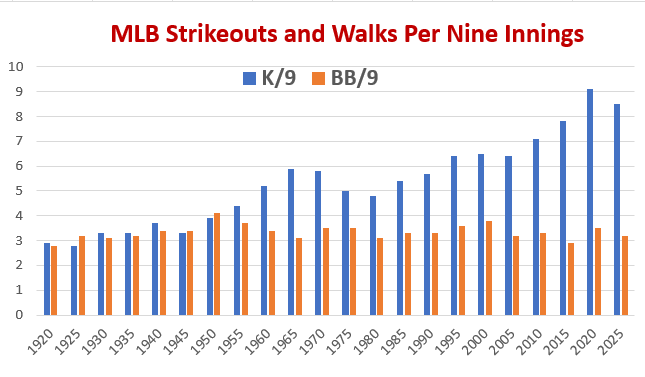
The 35.8% is up slightly from  the 35.0% through April in 2025, when the figure were:  strikeouts (22.1%); walks (9.0%); home runs (2.8%); HBP (1.0%); catcher’s interference (less than 1%). I’ve  also looked into full-year Trot Index figures for the years I have been a fan: 30.3% in 2010; 29.9% in 2000; 31.7% in 1990; 23.1% in 1980; 27.0% in 1970; 25.1% in 1960; and 22.8% in 1950.

_________________________________________


If the season ended May 30, your playoff teams would have been:

          AL:  Yankees, Athletics, Guardians. WC: Rays, Mariners, Tigers.

          NL: Braves, Dodgers, Reds.  WC: Padres, Cubs, Cardinals.

A few observations:

  • As of close of play April 30, the AL Central, without a single team over .500, would have two teams in the post-season; the same number as the NL Central, which did not have a single team under .500.
  • The Dodgers, with MLB’s highest payroll (per Sports Illustrated) are 20-11, in first place in the NL West.  The Mets, with MLB’s second-highest payroll,  are 10-21 (MLB’s worst  through April).
  • Four teams had at least 20 wins through April 30.The Yankees, Braves, Dodgers and Reds.  The first three are in the top nine in terms of salaries (third, eighth and first, respectively), the Reds are number-19.
  • The Reds lead the NL Central with a 20-11 record, despite a negative-three run differential, having been outscored 136-133 in March/April.  Three of the seven division leaders (one tie) have a negative run differentials:  Guardians (-8); Athletics (-5); Reds (-3).
  • The largest positive run differential is a plus-66, by both the Dodges and Braves, The largest negative run differential belongs to Phillies at minus-45.
  • The Nationals are not keeping the home crowds happy. There are 12-7 on the road, but 3-10 at home.
  • The Astros lead the AL in runs scored, but are 12-20 on the season.

Seeing Red, Rooting Red

Of special interest to me are the Reds, with a negative-three run differential, but a 20-11 record.  The three other teams with 20 or more wius have run differentials of +66 (Dodgers and Braves) and +47 (Yankees).  How are the Reds doing it – and can it be sustained?  First thing I noticed is that they have MLB’s best record in one-run games – a clean 7-0, as well as in extra-innings (3-0). They also have played just three games against teams over .500, 18 games against AL teams and only three games within their own division.  It looks like a challenge, but they have some interesting pieces and I’ll be rooting for them.

The offense, so far, has really gone through SS Elly De La Cruz (.282-10-24, with eight steals) and C Sal Stewart (.281-9-29).  Those two have driven in 39 percent of the Reds’ runs, scored 38 percent and knocked 45 percent of the team’s home runs.  They can expect some help from  DH Nathan Lowe (thus far .288-5-12) and LF Spencer Steer (.237-5-10), but they will need more balance on offense. DH/3B Eugenio Suarez – sidelined with an oblique issue –  has 328 homers on his resume (13 seasons) and, if he returns and heats up,  it could add depth to the lineup.

The Reds are missing sidelined starters  Hunter Greene (elbow surgery) and Nick Lodolo (blister)To this point, Chase Burns (3-1, 2.65) in six starts and Rhett Lowder (3-1, 3.18  in six starts) are leading the pitching, but the remainder of the rotation – Andrew Abbott, Brady Singer and Brandon Williamson have ERAs of 5.97, 4.97 and 6.11 as we enter May. (Williamson is now also on the IL).  Lodolo (9-8, 3.33 a year ago) is expected back soon and should strengthen the rotation.   The bullpen has been a strength  – particularly Graham Ashcraft (1.20 ERA in 15 games), Connor Phillips (2.04 in 16 games) and Brock Burke (0.63 in 15 games) and has played a major role in the Reds’ ability to win close games.  Closer Emilio Pagan has had some early struggles, perhaps tied to hamstring issue. If he ends up on the IL, Reds fans will likely see some new arms from Triple-A.

Overall, a lot will have to go right and some players will have to get healthy for the Reds to remain “in the hunt.”  Probably not in the cards over the long seasons, but hey have shown some grit to this point and they should be exciting/interesting to watch (think Elly De La Cruz).

——-Team Statistical Leaders March/April 2026 ———-

RUNS SCORED

National League – Braves (177); Nationals (175); Cubs (169)

American League – Astros (168); Twins (154); Yankees (153)

The fewest runs in March/April were scored by the Giants (104). In the American League, it was the Rangers (120).    

AVERAGE

National League – Dodgers (.273); Braves (.271); Cubs (.261)

American League – Astros (.265); Rays (.250); Tigers (.250)

The lowest team average for March/April belonged to the Reds at .220 – the White Sox were at the bottom of the NL at .225.

HOME RUNS

National League – Dodgers (45); Braves (43); Cubs (42); Reds (42)

American League – Yankees (48); Angels (42); Astros (40)

The fewest home runs in March/April were hit by the Giants (19). In the American League, it was the Red Sox, at 21. 

TOTAL BASES

National League – Braves (495); Dodgers (474) ; Cubs (457)

American League – Astros (482); Tigers (438); Yankees (430)

The Dodgers led MLB in March/April Slugging Percentage at .452. The Astros led the AL (.438)

DOUBLES

National League – Braves (61); Rockies (61); Diamondbacks (55)

American League – Astros (66); Tigers (62); Guardians (54)

TRIPLES

National League – D-backs (10); Marlins (8); Phillies (7)

American League – White Sox (6); Rays (5); Royals (5); Tigers (5)

 STOLEN BASES

National League – Brewers (36); Marlins (36); Nationals (32)

American League – Rays (34); Yankees (32); Rays (29); Twins (26)

The Giants stole the fewest sacks in March/April  at eight – in 12 attempts.  The Tigers stole the fewest bags in the AL – nine in 13 attempts.  

WALKS DRAWN

National League – Brewers (142); Cubs (141); Reds (128)

American League – Yankees (138); Angels (135); Twins (134)

The Cubs led MLB in March/April on-base percentage at .353. The Astros led the AL at .346. The Mets had MLB’s lowest March/April  OBP at .289.  The Red Sox anchored the AL at .309. 

BATTER’S STRIKEOUTS

National League – Pirates (306); Rockies (304); Reds (286)

American League – Angels (314); White Sox (290); Mariners (288)

Blue Jays’ batters fanned the fewest times in March/April (210). The D-backs fanned the fewest times in the NL at 240.

__________________________________________________

EARNED RUN AVERAGE

National League – Braves (3.12); Dodgers (3.19); Brewers (3.74)

American League – Yankees (3.11); Rangers (3.47); Mariners (3.67)

The Astros had the highest March/April ERA at 6.08.  The Nationals had the highest ERA in the NL at 5.08.

STRIKEOUTS

National League – Pirates (301); Phillies (291); Mets (289)

American League – Guardians (297); Blue Jays (294);  Astros (293);

The Blue Jays averaged an MLB-best 9.60 strikeouts per nine innings in March/April. The Phillies averaged an NL-best 9.51.  Eight teams averaged nine whiffs per nine or better.

FEWEST WALKS SURRENDERED

National League –   Cubs (94); Dodgers (97); Phillies (98)

American League – Mariners (80); Yankees (85); Rangers (96)

The Mariners walked an MLB-lowest 2.53 batters per nine innings in March/April.  The Astros walked an MLB-worst 5.66 batters per nine frames.

SAVES

National League – Padres (12); Braves (11); Cardinals (11)

American League – Rays (12); Athletics (11); Orioles (10); White Sox (10)

The Nationals  blew the most saves in March/April  – ten (in 17 opportunities).  The Astros had just one blown save in 7 opportunities.  

Walks + Hits/Innings Pitched (WHIP)

National League – Dodgers (1.12); Braves (1.16); Cubs (1.19)

American League:  Yankees (1.14); Rangers (1.21); Guardians (1.23)

Bonus Stats:

  • The Nationals gave up an MLB-high 52 home runs in March/April. The Padres gave up an MLB-low 35 home runs.
  • Dodgers’ pitchers held opponents to an MLB-low .210 average in March/April. The Phillies’ staff was touched for an MLB-high .280 average.
  • The Mariners’ strikeouts-to-walks ratio for March/April topped MLB at 3.23. The Astros had MLB’s worst ratio at 1.67.

—–2026 MARCH/APRIL HIGHLIGHTS—–

A “Home “Opener

The 2026 MLB season opened at 5:05 p.m., Wednesday,  March 26 in front of approximately 41,000 fans in San Francisco’s Oracle Park. March still seems a tad early, but there were some positives for me.  I was happy to see the National Pastime open with a game that took place in a true “home” ballpark.  As regular readers know, The Roundtable has never been fond of those “overseas” season openers, held in sports facilities where neither team is really the “home” squad and usually several days before the rest of MLB starts playing games that count. Score one for MLB (with me) on this one.

A few highlights and lowlights. The Yankees rocked the hometown Giants 7-0 (a highlight or lowlight depending on your allegiance). The first strikeout of the season can be credited to the first batter of the season. Giants’ starter Logan Webb fanned Yankee leadoff hitter CF Trent Grisham to open the game.  (Webb also fanned Yankee number-two hitter RF Aaron Judge, which proved to be more of a sign for what Judge would do than what Webb would accomplish.  (After his 1-2-3, two-strikeout first inning of the season, Giants’ ace Webb went on to last just five innings and gave up nine hits and seven runs – six earned – although he did fan seven.) Yankee slugger Judge struck out four times before putting the ball in play for a ninth-inning 5-3 groundout.)

Aaron Judge was the only member of the Yankee lineup to go hitless on Day One.

The first hit of 2026 went to Giants’ DH Rafael Devers (first-inning single); the first run scored to Yankees’  DH Giancarlo Stanton in the second inning (when the Bronx Bombers plated five runs versus Webb); the first RBI to Yankees’ SS  Jose Caballero, who plated Stanton with a second-inning single. There were no home runs in the game. In fact, 12 of the games’ combined 13 hits were singles (Grisham had a second-inning, two-run triple.) Webb of course, took the first loss of the season. Max Fried, who went 6 1/3 scoreless frames got the first win, and there was no save.

Let’s Get This Party Started … Two-for Two

In the season’s first week, we saw a pair players  go deep twice in their first-ever MLB regular-season game.

On March 26, Guardians 24-year-old rookie RF Chase DeLauter, batting second in his first regular-season MLB appearance (focus on the term “regular-season,”  it  will come into play), gave the Guardians a quick lead – homering (solo shot off the Mariners’ Logan Gilbert) in the  first inning. In the process, he joined the more than 140 players who have  gone deep in their  first MLB regular-season at bat. Then, in the ninth inning, DeLauter book-ended the  game and moved into more rarified air, adding a second solo homer (off Cooper Criswell) to join just six players to homer twice in their debut regular-season game.  Overall, DeLauter was three-for-five, with three runs scored and two RBI on the 6-4 Cleveland road win.

Why the regular-season modifier?  DeLauter actually made his MLB debut in last season’s AL Wild Card Series, going one-for-six in two games against Detroit (becoming just the seventh player to make his MLB debut in a post-season contest).

DeLauter  was a first-round pick (16 overall) in the 2022 MLB Draft, out of James Madison University  (where he hit .402-15-70 in three seasons (66 games). In three minor-league campaigns (138 games), he hit .302-20-87 .

Chasing a Good Story

Chase DeLauter hit four home runs in his  first three games (March 26-28) – going .357-4-5 in that span –  and joining Trevor Story (2016 Rockies) as one of two players to homer four times in their first three MLB regular-season games). DeLauter went one-for-three (a single) in his fourth game. That provided a bit of historic separation for Story, who  homered twice in his fourth MLB game (making him the only player with six long balls in his first four MLB games … #InBaseballWeCountEverything.) DeLauter ended April at .257-5-18.

On March 31, Diamondbacks 22-year-old rookie 3B Jose Fernandez (called up to replace and injured Pavin Smith)  also went deep twice in his MLB debut.  Fernandez, batting in the number-six hole, singled (off the Tigers’ Casey Mize) in the bottom of the second; hit a solo homer to left off Mize in the fourth; struck out (off Drew Anderson) in the seventh; and, in the eighth, hit a three-run homer to left-center (off Tigers’ closer Kenley Jansen) to give Arizona a 7-5 lead (which proved to be the final score).

The other six players to poke a pair of long balls in their first regular-season games were (per Elias Sports Bureau): Charlie Reilly (1889 Columbus Solons); Bob Nieman (1951 St. Louis Browns); Bert Campaneris (1964 Kansas City Athletics); Mark Quinn (1999 Kansas City Royals); J.P. Arencibia (2010 Toronto Blue Jays); and Trevor Story (2016 Colorado Rockies). Story is the only one of those who, like DeLauter, accomplished the feat on Opening Day.

Give Me Five, Mate, Okay, I’ll Take Four

Tigers’ 21-year-old rookie 3B Kevin McGonigle collected four hits in his March 26 (Opening Day) MLB Debut, just one hit shy of the all-time record for an MLB-debut outing and tying the record for an MLB-debut on Opening Day.

McGonigle hit a two-run double on the first major-league pitch he ever saw  (from the Padres’ Nick Pivetta in the top of the first). He doubled (again off Pivetta in the third); singled (off Ron Marinaccio) in the fifth; popped out to third (off Bradgley “Yes that how you Spell It” Rodriguez) in the seventh; and singled in the ninth (off Wandy Peralta.)

McGonigle was signed the first Round of the 2013 MLB Draft (37th overall), out of Monsignor Bonner and Archbishop Prendergast High School in Pennsylvania). In the minor leagues, including Fall League, he hit .313-3-149, with 45 steals (202 games).  The 21-year-old ended April at .328-2-13.

Two-for-Five

Two players have collected five hits in their major-league debuts: Fred Clarke of the 1894 Louisville Colonels (nine innings) and  Cecil Travis of the 1933 Nationals (12 innings). 

One For The Record Books

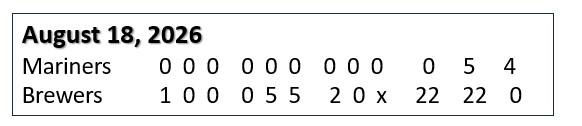
Photo: Drovetochicago, CC BY-SA 4.0 <https://creativecommons.org/licenses/by-sa/4.0>, via Wikimedia CommonsOn March 26, Brewers’ flame-throwing righty  Jacob Misiorowski got his first Opening Day Start – and he made the most of it.  Misiorowski, popularly called “The Miz”, fanned 11 White Sox batters in just five innings to set a new Brewers’ Opening Day high for Ks.  After giving up a home run to the first batter he faced in the 2026 season (White Sox 2B Chase Meidroth), Misiorowski fanned the numbers two, three and four hitters (SS Colson Montgomery, 3B Miguel Vargas and DH Andrew Benintendi) in succession. He fanned two more in the second; two in the third; three in the fourth and one in the fifth.

And The Miz wasn’t the only one having a good day in Milwaukee. The four relievers who followed Misiorowski to the mound added another nine strikeouts in their four innings – tying the MLB record for total strikeouts in a nine-inning game.  AND, the Brewers’ lineup contributed 12 hits  and 14 runs) as the Brew Crew triumphed 14-2 in front of 43,001 ecstatic fans (at least I think most were ecstatic).

Side Note: One April 25, Misiorowski started against the Pirates (in Milwaukee) and (as Ebby Calvin “Nuke” Laloosh, would have said ) “announced his presence with authority” early on. He fanned the first batter of the game, Pirates’ CF Oneil Cruz, on a 1-2 102.7 MPH four-seam fastball.  It was the fastest pitch for a strikeout by a starter since tracking began in 2008. “InBaseballWeTrackEverything.”

Do You Remember?

Jacob  Misiorowski made his MLB debut, as a 23-year-old,  on June 12, 2025.  At the time, he was 4-2, 2.13 at Triple-A Nashville, with 80 strikeouts (31 walks) in 63 1/3 innings.  With the Brewers, he  immediately began lighting up radar guns. His first two MLB pitches were clocked at 100.5- and 101.8-mph. In his first start, he reached triple-digits (100-mph or better) on 14 pitches. Next time out, he threw 29 triple-digit heaters over six-plus frames (he faced two batters in the seventh) – and he didn’t surrender a hit over his first 11 MLB innings.

In his first five MLB outings, Misiorowski went 4-1, 2.81, with 33 strikeouts in 25 2/3 innings.  Then came some startling (to some) news. On July 12, MLB announced that Misiorowski was going to join the NL All Star squad (as a replacement for the Cubs’ Matthew Boyd) for the July 15 All Star Game. It was the fewest number of games played  ever for an All Star selection … and there were those who maintained the honor should have gone to a more experienced hurler. 

The Miz, however,  shook it off – and didn’t disappoint. He pitched the eighth inning of the All Star Game, facing four batters (one single, three flyouts) and threw nine of his 18 pitches at 100+mph, the fastest at 103.3-mph.  He finished the 2025 season at 5-3, 4.36, with 87 strikeouts (33 walks) in 66 innings pitched. 

Blue Jays’ Kevin Gausman Rolls an Opening-Day Eleven

The Blue Jays opened the 2016 season at home against the A’s, with ace Kevin Gausman on the mound – and, like Jacob Misiorowski (above), he brought his A-Game to the A’s. Gausman went six innings, giving up one  hit and one run (a fourth-inning home run by A’s C Shea Langelier). Over his six frames, he also fanned eleven batters – setting a new Blue Jays’ record for strikeouts on Opening Day., Gausman, however, did not get the win (the Blue Jays triumphed 3-2, on a walk-off RBI single by SS Andres Gimenez with two out in the bottom of the ninth).

Langelier, by the way, drove in (and sored) both A’s runs – on a pair of Opening Day, solo homers; becoming just the fourth A’s player with a multi-homer Opening Day (Jason Giambi, 2000, two homers); Khris Davis, 2017, three homers); Tyler Soderstrom, 2025, two homers). Langeliers is coming off a solid .277-31-72 seasons in 2025 – and was .328-8-15 at the end of April

Mariners Going For a Little Extra

Over their first two games of the 2026 season, the Seattle Mariners collected nine hits and nary a single – becoming the first team in the Modern Era to go through the first two games of the season without a single single, and just the ninth team to have zero singles over any two-game span. Over those two contests (which they split), Mariners’ batters delivered two doubles, one triple and six home runs. The Mariners finally collected their first single of the season on March 28, in the third inning of their third game (Cal Raleigh) … their eleventh hit of the new season.

A Perfect Ten

Nationals’ outfielder Joey Wiemer (who came into the season with a career .205 MLB batting average … in 448 at bats over three seasons) got off to a pretty good start in 2026.

  • On March 26, he went home run, walk, single, single as the Nationals topped the Cubs 10-4;
  • On March 27, he did not play, as the Nationals lost to the Cubs 2-10;
  • March 28, back in the lineup, Wiemer went home run, triple, walk, single in a Nats’ 6-3 win over the Cubs;
  • On March 29, it was single, single, groundout, flyout, walk in a 13-2 win over the Phillies.

If you look closely that those results, you will see that Wiemer reached base safely in his first ten plate appearances of the 2026 season.  That tied Carlos Delgado (2002) for the most consecutive plate appearances to reach base safely to start a season in the live-ball ERA (since 1920). Yes, again in baseball we count everything, and also accept many qualifiers.

Celebrating 50 with 50

The Blue Jays are celebrating their franchise’s 50th Anniversary and they got off to a pretty good start. They opened the season, with a three-game, home-field sweep of the A’s (3-2. 8-7 and 5-2 on March 27,28 29). In the process, Blue Jays’ hurlers fanned fifty batters over the three games – the most strikeouts recorded by an MLB team in its first three games of a season EVER.  In the first game, four Blue Jays pitchers recorded 16 strikeouts (led by starter Kevin Gausman’s 11 in six innings). In Game Two, an 11-inning affair, eight Blue Jays hurlers recorded 19 strikeouts (led by starter Dylan Cease’s 12 in 5 1/3 innings); In Game Three, five Blue Jays’ moundsmen fanned 15 batters (led by starter Eric Lauer’s nine in 5 1/3 innings).

Happy Birthday To Me

March 28, was Dodgers’ C Will Smith’s 31st birthday. It was also the night the Dodgers were handing out bobbleheads celebrating Smith’s go-ahead homer in Game Seven of the 2025 World Series. Keeping with what seems to be a power theme in 2026 (homers and strikeouts), Smith celebrated in style. Popping an eighth-inning, two-run, go-ahead home run that provided the margin in a 3-2 Dodgers’ win over the Diamondbacks.

2026’s First Immaculate Inning

On March 30, the Diamondbacks picked up their first win of the new season – a 9-6 triumph over the Tigers. In the top of the fifth inning of that game, with the Diamondbacks already up 5-0, D-backs’ starter Mike Soroka gave the fans an extra “treat” – tossing the first Immaculate Inning (three-up, three-down, nine pitches, three strikeouts) of the 2026 season. Soroka’s victims were Tigers’ 9-1-2 hitters (SS Javier Baez, RF Kerry Carpenter, and 2B Gleyber Torres). All three went down swinging. In keeping with 2026’s early theme of strikeouts and home runs, Soroka tied his career high for strikeouts in a game, fanning ten in five innings (four hits, one walk, no runs).

You Fellas Catch On Fast

The first 2026 MLB Player of the Week awards (for March 25-29) went to Guardians’ OF Chase DeLauter and the Reds’ 1B Sal Stewart. Not only were they both from Ohio-based teams, their recognitions marked just the second time that a pair of rookies won a season’s inaugural Player of the Week Awards (after the Rockies’ Trevor Story and Astros’ Tyler White in 2016).

DeLauter went 6-for-17 (.353) with four home runs, five RBI and five runs scored in four games. Stewart went 7-for-10 (.700), with a home run, three doubles, two runs scored and two RBI in three games.

The International Game

From March 30 through April 1, the Dodgers starting pitcher were Roki Sasaki, Shohei Ohtani, and Yoshinobu Yamamoto. See a pattern here? Elias Sports Bureau reports that it’s the first time an MLB team has started Japanese-born pitchers in three consecutive games. More #InBasebvallWeCountEverything.

April Fool’s Day, Appropriately

April 1 saw the first MLB game to end on a challenging note – a strikeout produced by the new ABS challenge process. (Fortunately, it was not a one-run ball game.) It happened with the Texas Rangers at bat in the bottom of the ninth inning, with two outs, no one on base, Texas down 8-3 and Rangers’ CF  Evan Carter facing the Orioles’ Albert Suarez.  Suarez delivered a high fastball to Carter on a 1-2 count. The pitch was originally called a ball by home plate umpire Manny Gonzalez, but Orioles’ catcher Sam Basallo challenged the call and, upon review, the pitch was ruled not high, but high in the zone, for a game-ending strikeout.  Side note:  The Roundtable is not a fan of the challenge system.

Wow, I Thought It Would Be Harder Than This

Giants’ 24-year-old  rookie catcher Daniel Susac made his first MLB plate appearances on April 2 (he did play three innings behind the plate on April 1). Here’s how his plate appearances on April 2 went: leadoff single in the second; single in the third; walk in the fifth; single in the seventh. His next plate appearances came on April 7, and he delivered another single in the second inning; another single in the fifth. Finally, in the seventh inning of that contest, he flied out to right.  But in his first six MLB plate appearances: five singles and a walk. That singles him out for an appearance in these highlights.

Susac finished April at .478-0-5 in 11 games.  In 2025, at Triple-A Las Vegas, he was .275-18-68 in 97 games.

The Home run That Was … Three That Weren’t … A Sweet Adell-line

As the Angels faced off against the Mariners (in Seattle) on April 4, Angels’ SS and  leadoff hitter Zach Neto got them off to a good start. Neto homered on the third pitch of the game (an 0-2 pitch  from Mariners’ starter Emerson Hancock) in the bottom of the first to give LA a 1-0 lead. That lead held up for a 1-0 Angels’ win, thanks to a sweet show by Angels right-fielder Jo Adell. Adell went high above the RF wall – and even into the right field stands to rob the Mariners not just of one, or two, but three home runs.

In the first frame, it was a leaping catch above the home run marker on the right field wall to rob Seattle C Cal Raleigh of a home run. In the eighth, another Adell leaping grab at the limits of the outfield, took a home run away from 1B Josh Naylor.  Then, Adell topped it off, with a ninth-inning catch, on a long fly off the bat of SS J.P. Crawford that ended with Adell, ball in glove, clearing the lower wall near the RF foul pole and  landing among the  fans in the right field seats. Three Adell robberies and — Game, Set , Match.

In an MLB.com article, Jared Greenspan reports that , after the game, Angels’ Manager Kurt Suzuki termed the contest “The Jo Show’ and Angels’ Special Assistant Torii Hunter (himself a nine-time Gold Glover and master of the home-run steal) termed it “the greatest defensive game I’ve ever seen.”

How big of a deal was this? The glove Adell used in his Tri-Way Robbery is now at the Baseball Hall of Fame in Cooperstown.

Bullpen By Committee, Indeed

From April 6 through April 9, the Twins put together a four-game winning streak. Now, that’s not exactly highlight-worthy.  What is,  however, is the fact that over that time, they recorded four saves – each by a different pitcher (and, in each case, it was their first save of the season).  It started with an April 6, 7-3 win over the Tigers (in Minnesota), with Cody Lawyerson  going 1 2/3 scoreless innings for his first career save. On April 7, the Twins topped the Tigers 4-2, with the save going to righty Justin Topa (2/3 of an innings, also scoreless). Then, on April 8, the Twins topped Detroit 8-6, with the save going to Kody Funderburk (Topa and Lawyerson also pitched in that game). Funderburk, like Topa, pitched 2/3 of an inning (scoreless).  On April 9, it was Eric Orze’s turn, and he pitched one scoreless frame, getting the save, as the Twins topped the Tigers 3-1.

More #InBaseballWeCount(andtrack)Everything

On April 10, the Dodgers’ 3B Max Muncy muscled LA to an 8-7 win over the Rangers (in LA). Muncy went four-for-five, scored four runs and drove in three. His hits included a solo homer in the second inning; a solo home run in the fourth; and a walk-off solo homer, on an 0-2 pitch, with two outs in the bottom of the ninth. (That last one had to be a shocker to the Rangers. Reliever Jacob Latz had come in and fanned C Will Smith and 1B Freddie Freeman, before getting Muncy down 0-2.) Post-game reports from the Elias Sports Bureau indicated that only one other Dodger has had a three-homer game that included a walk-off shot:  CF Don Demeter, versus the Giants in an April 21, 1959 9-7 Dodger win in LA.  In that one, Demeter went three-for-five, with three runs scored and six RBI.

Should Jose Ask For A Trade

On April 11, the Guardian’s Jose Ramirez popped a first-inning solo home run off an 0-2 pitch from Braves’ starter Martin Perez. Not only was it the first run in an eventual 6-0 Cleveland win, it was Ramirez’ first home run off an Atlanta pitcher – and gave Ramirez – who has played all 14 of his MLB seasons for Cleveland, the distinction of being the first player with a regular-season homer against all the other (29) MLB franchises while in a Cleveland uniform (Elias Sports Bureau).  For those who are interested in such things, 87 players have homered (regular season) against all thirty franchises in their careers.  The first was Ellis Burks, who completed the tour in April of 2000. The most recent was Trevor Story, who put notch number 30 on his belt last September.

Coincidence? The Evidence Says Otherwise.

On April 14, the Cubs topped the Phillies 10-4 in Philadelphia, setting a pair  of streaks in motion.  The Cubs would not lose another game until April 25, while the Phillies would lose every game until April 25 – a ten-game winning streak for Chicago and a ten-game losing streak for Philadelphia. You can wave off “coincidence” in this one.  In the course of the two streaks, the Cubs and Phillies faced each other six times (six wins, of course, for Chicago – six losses for Philadelphia). In those six games, the Cubs outscored the Phillies   48-20.

From April 10 through April 24, in their ten-game losing streak (five home and five road games), the Phillies  were outscored 69-26, outhit .298-to-.202, outhomered 17-to-12 and put up a 6.77 earned run average to their opponents’ 2.27.  In that same time period, the Cubs ten-game winning streak (seven home and three road games), Chicago outscored  their opponents 72-to-21, outhit them .324-to-.220, outhomered them 17-to-10 and put up a 2.93 ERA to the opponents’ 6.91.

Climbing The Ladder … Big Steps Ahead

On April 14, Tigers’ closer Kenley Jansen, picked up his third  save of the season,  tossing a scoreless ninth (one hit), as Detroit bested Kansas City 2-1. Even more notably, it was his 479th career save, moving him into sole position of third place on the all-time saves list (passing Lee Smith).   The next targets for the 38-year-old righty are off in the distance. Ahead of Jansen on the saves list are: Mariano Rivera (652 saves) and Trevor Hoffman (601 saves). Jansen has, as of late, become a bit of a traveling savesman. After saving 350 games for the Dodgers from 2010 through 2022, he has found himself closing out games for the Braves (2022), Red Sox (2023-24), Angels (2025) and Tigers.

Trout Takes A Bite Out Of The Big Apple

As the Yankees and Angels split a four-game series in New York (April 13-16), the Angels’ Mike Trout wrote a new chapter in Yankee Stadium history – becoming just the second visiting  player to homer in four straight  games in Yankee Stadium (tying John Mayberry Sr., 1972) .  Over the four-game series, Trout went  six-for-sixteen (.375) with five home runs and nine RBI. His five homers were also the most ever in a regular-season series against the Yankees in New York. George Bell (1990), Darrell Evans (1985) and Jimmie Fox (1933) also hit five homers in a series against the Bronx Bombers, but those were Toronto, Detroit and Philadelphia, respectively.

Hang The Bunting, It’s a Win

Op April 16, the Brewers took “small ball” to a new level. Tied with the Blue Jays 1-1 in the bottom of the seventh, Brewers’ PH Garrett Mitchell drew an inning opening walk on a 3-2 pitch from Tommy Nance. Greg Jones then bunted, sacrificing Mitchell to second. Joe Mantiply came in to pitch and, on his first pitch, David Hamilton laid down a beautiful bunt (for a base hit), moving Mitchell to third.  SS Joey Ortiz next bunted (a sacrifice) scoring Mitchell, before Brandon  Lockridge struck out to end the inning – and Milwaukee made that run (scored on a walk and three consecutive bunts) hold up for a 2-1 win.  That’s small ball.

Worth The Wait … A Feel-Good Story

After toiling seven years and 700 games in the minors, Ryan Ward finally got his call to “The Show.”  He started at first base in his first MLB game on April 19  (for the Dodgers versus the Rockies) and went two-for-five with one RBI.   An eighth-round pick in the 2019 draft out of Bryant University (where he hit .383-23-111 in 124 games over three seasons), Ward hit .266-154-524 over seven minor-league campaigns.

Let’s Get This Party Started

On April 20, as the Dodgers crushed the Rockies 12-3, Dodgers’ 1B (he also plays catcher) Dalton Rushing went 2-for-5, with two runs scored and three RBI – bringing his stat line to .444-7-13 over his first eight games of 2026. That put Rushing in a tie (with Trevor Story, 2016) for the second-most long balls in a player’s first eight games of a season (one behind Mike Schmidt, 1976).  Just a bit more of  #InBaseballWeCountEverything.  Rushing – a 2022 second-round draft pick  out of the University of a Louisville – made his MLB debut in 2025, going .204—2-24 on 53 games for LA.

Ha! Ya Missed Me!

Cardinals’ second baseman JJ Weatherholt was probably happy to avoid a “hit” on April 21.  The game saw an end to his streak of getting hit by a pitch.  From April 15 through April 19, he was nailed in five consecutive games  … one game short of the Modern-Era record (Carlos Quentin, 2008 White Sox). Over his streak, Wetherholt hit .214 (3-for-14), but had a .500 on-base percentage, thanks to four walks and his five HBP.

Will April Never Be Over?

On April 22, the Mets had cause for celebration, after squeaking out a 3-2 win in front of 32.665 fan at Citi Field. It marked the Mets’ first victory  since April 7 – a 12-game losing streak in which the Mets – with a payroll second in MLB only to the Dodgers – looked absolutely lost (pun intended). Over that 12-game span, the Mets were outscored 67-21; outhit .257-to-.194; outhomered 15-to-8; and put up a 6.22 earned run average to their opponents’ 1.65.  The losing streak included six home and six road games; three one-run games (one in extra frames); three shutouts; and eight games in which the Mets scored two or fewer runs.

Side note:  The night before, in a Mets 5-3 loss to the Twins, I saw (watched on TV) how truly difficult it can be to play in the Big Apple. In that one, the Mets took a 3-0 lead into the fifth before the Twins mounted the comeback that would eventually lead to their victory. As the Twins clawed their way back in, Mets’ fans – a significant number with brown paper bags over their heads – began booing their home team with an energy I had not before  seen directed at a home squad.  Noisy displeasure continued – and rose in volume – until the Twins had a two-run lead, with the bases loaded and not outs in the top of the ninth. At that point,  Mets’ reliever Austin Warren was brought into the game and, when he struck out the first batter he faced, the fans began a sarcastic chant of “MVP, MVP.” Warren, however, was not rattled, as he fanned three consecutive batters with the sacks full to hold the Twins lead at two.

The Mets, by the way, ended April with a 10-21, the worst record MLB.

Something Weird. Right Off The Bat.

On April 22, in the top of the first inning of an eventual Mariners 5-4 win over the Athletics, the baseball Gods, provided 15,704 fans a play they will never forget,  Logan Gilbert was on the mound for the Mariners and had given up a walk to Athletics leadoff hitter  Nick Kurtz and a single to C Shea Langeliers (sending Kurtz to third). Next up was Carlos Cortez, who hit a 2-1 pitch right on the button – and right up the middle into Gilbert’s shirt. Gilbert, not knowing exactly where the ball had lodged, search the mound area for the ball, before realizing it was stuck in his shirt. The call? Based on the rule that a batted ball going inside a player’s or coach’s uniform is “out of play,” the batter is credited with a hit and any runners are placed at the umpire’s discretion. So, Cortez was credited with a base hit, Langeliers moved to second, but (via umpire discretion) Kurtz was kept at third. (Both runners eventually scored). I wonder how many fans, fifteen seasons from now, will claim to have been in the stands that day?

Below is a YouTube video from Swing and Miss:


Boomer Murakami … More Home Run Talk

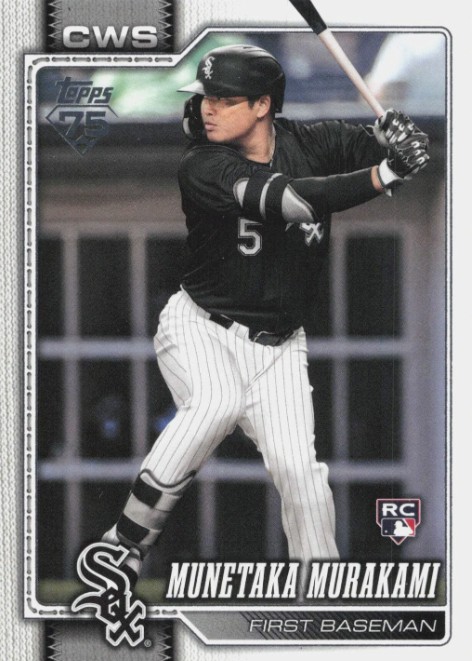
From April 17 through April 22, White Sox 26-year-old rookie 1B Munetaka Murakami (signed by the ChiSox out of Japan, where he was a two-time MVP and four-time All Star) homered in five straight games, going .500 (11-for-22), with five home runs, ten RBI and seven runs scored in that span). In the process, he tied the MLB rookie record for consecutive games with a home run. Murakami ended April at  .236-12-23, his 12 omers tying for the MLB lead.

Munetaka Murakami finished April tied for the MLB lead in home runs with 12. Notably, he had just 12 extra-base hits in March April – all, of course, homers.  

All Good Things Must Come To An End

On April 22,  as the Dodgers lost to the Giants in San Francisco, Shohei Ohtani failed to reach base in a game in which he batted for the first time since August 23, 2025.  That’s a pretty good achievement for a guy who can also bring the heat from the mound. The on-base record, by the way, belongs to Ted Williams, who reached base in 84 consecutive games from July 1, 1949 to September 27 1949. During his streak, Williams hit .371-24-80.  During nis streak, Ohtani batted .279-16-30.

First, He Didn’t Walk, Then He Had To Run

On April 23, Ranger CF Evan Carter came to the plate in the bottom third inning of a scoreless game against the Pirates with a runner on first and two out. With a three-and-one count, he took what he thought was ball four (as did the ump) and prepared for a leisurely stroll to first base.  Just a second there, Bucco! Pirates’ catcher Joey Bart challenged the call and it became strike two.  Back at the plate, Carter smacked the next pitch to deep right-center, where it bounced off RF Ryan O’Hearn’s glove, caromed off the centerfield wall and was retrieved by CF Oneil Cruz. Carter, meanwhile, replaced his original stroll to first base with a mad dash around the bases, sliding head first into home plate with the first inside-the-park homer of his career.

April Showers … Birds’ Homers

On April 24, the Orioles gave 26,776 fans at Camden Yards an April treat. No only did they even their record at 13-13 with a 10-3 win over the Red Sox, they delivered an April shower of hits (20) and home runs (six). The game saw two homers by C  Adley Rutschman and one each by SS Gunnar Henderson, RF Dylan Beavers, DH Sam Basallo and 3B Coby Mayo – and five Orioles collected  three or more base hits.

Not Much Time To Celebrate.

On April 25, the Red Sox – suffering through a rough (9-17) start to the season –  exploded for  for a 17-1 win over the Orioles in Baltimore.  The Sox put an exclamation point on the final inning of the game, scoring ten runs in the ninth frame on ten hits (including a Grand Slam by DH Andruw Monasterio,  a two-run shot by 3B Caleb Durbin and a three-run blast by  1B Willson Contreras). It was the first time in team history that the Sox had launched three ninth-inning home runs and just the second time Boston had plated ten ninth-inning runs. Every coin has two sides: The final four runs were charged to infielder Weston Wilson, making his fourth career mound appearance, and the  17 runs also matched the Red Sox’ total scoring over the previous seven games (one win and six losses).

The Red Sox did not have much to celebrate the breakout victory. Later that same day, the last-place Red Sox announced the firing of manager Alex Cora and five members of his coaching staff, as well as the reassignment of a sixth coach.

My (Banana) Dreams Are Shattered

April 27, the  Guardians announced  they were calling up 2B  Travis Bazzana, the first overall pick in the 2024 MLB draft, out of Oregon State University – where he hit .360-45-165, with 66 steals in three seasons (184 games).  Bazzano was hitting .287-2-10, with eight steals at Triple-A at the time of the announcement. I wish him luck in the majors, but my dream of seeing Travis Bazzana on the field for the Savannah Bananas have been dashed.

Mason Miller Finally Gives One Up

On April 27, Padres’ hard-throwing reliever Mason Miller  finally gave up a run, stopping a 34 2/3 consecutive scoreless innings streak that goes back to August 6 of last season – a stretch of 33 games, 34 2/3 innings, 11 walks, 69 strikeouts, one win, 12 saves and nine holds.

Called in for the bottom of the ninth, with his Padres up 9-5 over the Cubs, Mason’s inning went: single; single; single (loading the bases); forceout at second (run scores); wild pitch (another run scores); groundout; strikeout. (In all fairness, the first single was on a slow roller down the third baseline that appeared to roll foul.)

For those who like to know such things, the longest stretch of consecutive scoreless innings by a reliever is 41 (Gregg Olson, Orioles (August 4, 1989-May 4, 1990). For a pitcher, any role, the record is 59 consecutive scoreless innings by Orel Hershiser, Dodgers (August 30-September 28, 1988).

From Both Sides Now

On  April 28, White Sox C Drew Romo hit the first two homers of his three-season MLB career (in his 30th career game). They deserve a note here because Romo (batting ninth), homered from the left-handed batter’s box (on an 0-2 pitch from the Angels’ Jose Soriano) in the bottom of the fourth and, in his next at bat, in the bottom of the sixth, from the right-handed batter’s box (on an 0-0 pitch from Brent Suter). Romo is just the seventh player to record their first two home runs, in the same game, from opposite sides of the plate – and one of only three (joining Yasmani Grandal and U.L. Washington) to accomplish the feat in consecutive plate appearances. More #InBaseballWeCountEverything. (The Sox won the game 5-2).

I Walk The Line … A Lot

From April 10 through April 30, A’s   1B Nick Kurtz drew at least one walk in  19 consecutive games – an active streak as he goes into May. His line over that span: (16-for-65) .246-5-13, with 24 walks, 25 strikeouts and a .449 on-base percentage. For those who like to know such things, the record for the most consecutive games drawing a walk (22) belongs to the Tigers’ R0y Cullenbine (1947).

Another Streak

You can read more about tis in the Surprise Player of the Month section near the top of this post, but Red utility player Ildemaro Vargas, closed out April with an active 23-game, season -opoening hnitting streak (and an active 26-game streak darting back to the end of 2025.

Mattingly For The Win

On April 28, the Phillies (with a 9-19 record) parted ways with manager Rob Thomson and brought in interim-manager Don Mattingly. The Philadelphia squad won its first game under Mattingly (April 28) 7-0 over the Giants (in Philadelphia).  Then, on April 30, they notched a pair of walk-off wins (3-2 and 6-5 in ten innings) in a split doubleheader, giving Mattingly a 3-0 record at the helm. It marked the first time the Phillies notched two walk-off wins in the same day since 1998 and the first time any team notched two walk-off wins in the same day since the Pirates in 2004.


–INDIVIDUAL STAT LEADERS FOR March/April—

BATTING AVERAGE (at least 75 at bats)

American League:  Jordan Alvarez, Astros (.356); Vlad Guerrero, Jr., Blue Jays (,354);  Yandy Diaz, Rays (.330)

National League: Ildemaro Vargas, D-backs (.378); Xavier Edwards, Marlins (.336); Jose Fernandez, D-backs (.325)

The lowest March/April average among players with at least 75 at bats belonged to the Rays’ Cedric Mullins at .126 (12-for-95).

HITS

American League: Yordan Alvarez, Astros (42); Shea Langeliers, Athletics (41); Vlad Guerrero, Jr., Blue Jays (40)

National League: Ozzie Albies, Braves (40); Drake Baldwin, Braves (40); Xavier Edwards, Marlins (38); Otto Lopez, Marlins (38)

The Braves’ Matt Olson led all MLBers in March/April extra-base hits with 22 – 13 doubles and five home runs.  

HOME RUNS

American League: Yordan Alvarez, Astros (12); Aaron Judge, Yankees (12); Munetaka Murakami, White Sox (12)

National League: Kyle Schwarber, Phillies (10=1); James Wood, Nationals (10); Elly De La Cruz, Reds (10) ;

The Astros’ Yordan Alvarez led all players with at least 75 March/April at bats in slugging percentage at .737. The D-backs Ildemaro Vargas led the NL at .689.

RUNS BATTED IN

American League: Yordan Alvarez, Astros (27); Jonathan Aranda, Rays (25); Christian Walker, Astros (24); Jeremiah Jackson, Orioles (24)

National League: Sal Stewart, Reds (29); Matt Olson, Braves (28); Liam Hicks, Marlins (28)

RUNS SCORED

American League:  Mike Trout, Angels (29); Ben Rice, Yankees (26); Yordan Alvarez, Astros (25); Aaron Judge,Yankees (25)

National League: Drake Baldwin, Braves (30); James Wood, Nationals (30); Matt Olson, Braves (27);  JJ Wetherholt, Cardinals (27)

DOUBLES

American League: Ernie Clement, Blue Jays (13); Taylor Ward, Orioles (13); Josh Jung, Rangers (11); Kevin McGonigle, Tigers (11)

National League: Matt Olson, Braves (13); Willy Adames, Giants (10); Gavin Sheets, Padres (9)

TRIPLES

American League:  Nine with two

National League: Corbin Carroll, D-backs (4); Geraldo Perdomo, D-backs (3); nine with two

STOLEN BASES

American League:  Jose Caballero, Yankees (12); Jose Ramirez, Guardians (12); Chandler Simpson, Rays (11)

National League: Nasim Nunez, Nationals (14); Oneil Cruz, Pirates (10); Jakob Marsee, Marlins (10)

The Guardians’ Jose Ramirez  stole the most March/April bases without getting caught (12).

BATTER’S STRIKEOUTS

American League:  Zack Neto, Angels (47); Munetaka Murakami, White Sox (46); Nick Kurtz, Athletics (45)

National League: James Wood, Nationals (50); Oneil Cruz, Pirates (48); Hunter Goodman, Rockies (46)

WALKS

American League:  Nick Kurtz, Athletics (33); Mike Trout, Angels (32); Taylor Ward, Orioles (27)

National League: James Wood, Nationals (31); Ivan Herrera, Cardinals (25); Bryan Reynolds, Pirates (25)

The Highest on-base percentage among players with at least 75 March/April at bats was .462, by the Astros’ Yordan Alvarez. The NL leader was the Marlins’ Xaviere Edwards at .432.

__________________________________

PITCHING VICTORIES

American League:  Jose Soriano, Angels (5-1); Gavin Williams, Guardians (5-1); five with 4

National League:  Aaron Ashby, Brewers (5-0); Landen Roupp, Giants (5-1); Chris Sale, Braves (5-1)

Twelve MLB pitchers finished March/April with four losses.

EARNED RUN AVERAGE (minimum 25 March/April innings)

American League: Jose Soriano, Angels (0.84); Cam Schlittler, Yankees (1.51); Nick Martinez, Rays (1.70)

National League: Shohei Ohtani, Dodgers (0.60); Justin Wrobleski, Dodgers (1.50): Clay Holmes, Mets, 1.75. (1.88)

STRIKEOUTS

American League: Gavin Williams, Guardians (53K / 43 1/3 IP); Dylan Cease, Blue Jays (49K / 31 1/3 IP); Jose Soriano, Angels (49K / 41 2/3 IP); Cam Schlittler, Yankees (49K / 41 2/3 IP)

National League: Jacob Misiorowski, Brewers (51K / 32 2/3 IP); Christopher Sanchez, Phillies (50K / 40 1/3 IP);  Tyler Glasnow, Dodgers (47K / 38 2/3 IP)

WALKS + HITS/INNINGS PITCHED (at least 25 March/April innings)

American League: Cam Schlittler, Yankees (0.74); Max Fried,m Yankees (0.80); Drew Rasmussen, Rays (0.85)

National League: Tyler Glasnow, Dodgers (0.83); Nolan McLean, Mets (0.85); Paul Skenes, Pirates (0.85)

Among pitchers with at least 25 March/April innings, the Dodgers’ Tyler Glasnow held batters to the lowest average at .146.

SAVES

American League:  David Bednar, Yankees (9); five with seven

National League:  Mason Miller, Padres (10); Riley O’Brien, Cardinals (8) ; Paul Sewald, D-backs (7)

Mason Miller of the Padres saved the most games without a blown save in March/April (ten).  

Bonus:

Among pitchers who faced at least 75 batters in March/April:

  • The Blue Jays’ Dylan Cease fanned the most batters per nine innings at 14.07, the Brewers Jacob Misiorowski was right on his tail at 14.05;
  • The Yankees’ Cam Schlittler had the best strikeouts-to-walks ratio at 8.17. (He walked six batters and fanned 419 in 41 2/3 innings.)

Zack Littell of the Nationals gave up the most March/April home runs … 13 roundtrippers in 28 2/3 innings. 


Primary Resources: MLB.com; Stathead.com; Get To Know D-Backs Top Pick Druw Jones, by Manny Randhawa;  Highest Major League Baseball Payrolls and Player Salaries for 2026 Season, by Kyle Koster, Sports Illustrated.

Baseball Roundtable – Blogging Baseball Since 2012.

Baseball Roundtable is on the Feedspot list of the Top 100 Baseball Blogs. For the full list click here

I tweet (on X) baseball @DavidBaseballRT. Follow me for new blog post notifications.

Follow Baseball Roundtable’s Facebook Page here.  


Member: Society for American Baseball Research (SABR); Negro Leagues Baseball Museum; The Baseball Reliquary.

P 1164


Baseball Roundtable Trivia(l) Tidbit Tuesday … MLB’s Longest Season-Opening Losing Streak

It’s Tuesday and that means it’s time again for Baseball Roundtable’s Trivia(l) Tidbit Tuesday. I hope you are enjoying this weekly presentation of baseball occurrences that for some reason caught The Roundtable’s eye.  (I’m particularly fond of unexpected performances and statistical coincidences.) These won’t necessarily be momentous occurrences, just events, statistics or coincidences that grabbed my attention. I’m also drawn to baseball “unicorns,” one-of-a-kind MLB accomplishments or statistics.

Last week, we looked at the only MLB pitcher to win 20 or more games AND two World Series games in a rookie season. For that post, click here. This week, we’re looking at the longest season-opening losing streak in MLB  history.

On this date (April 28) in 1988, the Baltimore Orioles were in town, facing off against my Minnesota Twins in the Metrodome. It was a fairly nondescript game, a Twins 4-2 win in front of 23,006 fans.  Each team had six hits, with the Twins scoring on a tw0-run fourth-inning homer by 1B Kent Hrbek and a two-run, sixth-inning double by LF John Moses – and the Orioles scoring on a first-inning groundout by 1B Eddie Murray (on which LF Tito Landrum scored) and a fourth-inning, bases-loaded walk (Mike Mason pitching to Landrum).  Mike Boddicker was the losing pitcher; Allan Anderson got the win.

So why is this game worth a tidbit? Because, on that day, the Twins handed the Orioles’ their twenty-first consecutive loss (from the start of the season) – still the record for the deepest into a season any team has gone without a win. The very next day, the Orioles broke the losing streak with a 9-0 win over the White Sox, but history was made. This tidbit takes a look at the Orioles record-breaking start to the 1988 season. Orioles’ fans may want to look away.

There were of a pair Ripkens on the 1988 Orioles: SS Cal Ripken, Jr.; and 2B/3B Billy Ripken.

First, coming into that 21st game, the 0-20 Orioles were (of course) 16 games out of first place just 20 games into the season. (They would go on to finish 54-107, 34 ½ games out of first.) The leadoff hitter for Baltimore that day (names are omitted to protect the innocent) was hitting just .091 and there were four sub-.200 hitters in the lineup.  No player in the Oriole lineup had more than two home runs, nor more than six RBI. The starting pitcher was 0-4, 7.40. Side note: After suffering that 21st loss, the Orioles moved on to Chicago, where they won the first game of a three-game series 9-0.  

Cal Ripken Sr. opened the 1988 season as the Orioles’ manager, coming off a 67-95 1987 season, but was let go after an 0-6 start (during which the Orioles were outscored 43-to-7), with Frank Robinson taking over the team.

To truly understand the depth of Baltimore’s start to the 1988 season, you have to look at the 21-game, season-opening losing streak as a whole.  First, there hints of disaster right from the start. The Orioles opened at home, against the Brewers, and treated 52,395 fans to a 12-0 loss. A portent of things to come?

In their first 21 games, the Orioles were:

  • Outscored 129-44;
  • Outhit .311-to-.193;
  • Outhomered 21-9;
  • Put up a 5.92 earned run average to the opponents’ 2.02; and
  • Made 21 errors to the opposition’s 12.

The streak consisted of 13 road games and eight home contests.  The Orioles scored one run or less in ten games (shutout three times) and lost seven games by five or more runs.

The streak included five one-run losses (one extra-inning game). In one particular point in the streak (games 9-11), the Orioles suffered three tough one-run home losses.

  • On April 14, they lost to the Royals 4-3, when Kansas City scored the winning run on an outfield error with two outs in the top of the ninth inning (and the game knotted at three apiece.)
  • On April 15, they lost 3-2 to the Indians, after leading 2-1 through the seventh inning.
  • On April 16, they lost a heartbreaker 1-0 to the Indians in eleven innings, despite outhitting Cleveland 8-3.  In that one, the go-ahead run scored on a two-out single, after a pair of walks and a passed ball.  The Orioles had a chance in the bottom of the eleventh frame, with runners on second and third with just one out, but could not push a run across.

The only regular-season MLB losing streaks longer than the Orioles’ 1988 season-opening belong to the: 1889 Louisville Colonels (26 games); and 1961 Phillies (23 games), but these were not season-opening streaks.  

Primary Resource: Stathead.com

Baseball Roundtable – Blogging Baseball Since 2012.

Baseball Roundtable is on the Feedspot list of the Top 100 Baseball Blogs. For the full list click here

I tweet (on X) baseball @DavidBaseballRT. Follow me for new blog post notifications.

Follow Baseball Roundtable’s Facebook Page here.  


Member: Society for American Baseball Research (SABR); Negro Leagues Baseball Museum; The Baseball Reliquary.

P 1163

Baseball Roundtable Trivia(l) Tidbit Tuesday … Riding a Rookie Arm, All the Way to A World Series Championship

It’s Tuesday and that means it’s time again for Baseball Roundtable’s Trivia(l) Tidbit Tuesday. I hope you are enjoying this weekly presentation of baseball occurrences that for some reason caught The Roundtable’s eye.  (I’m particularly fond of unexpected performances and statistical coincidences.) These won’t necessarily be momentous occurrences, just events, statistics or coincidences that grabbed my attention. I’m also drawn to baseball “unicorns,” one-of-a-kind MLB accomplishments or statistics.

This week, we’re looking at an MLB “unicorn” … and the answer to the question “Who is the only MLB pitcher to win twenty games AND win two World Series games in a rookie season?”

I should note it took a while to establish these unicorn credentials. For example, I did find 33 Modern Era (post-1900) qualifying rookies who won 20 or more games –  including Grover Alexander, who set the Modern Era record for wins by a rookie with 28 (28-13, 2.57), as a 24-year-old  MLB freshman with the 1911 Phillies.  That season, Alexander led the NL in wins, complete games (31), shutouts (seven) and innings pitched (367).  I also found 11 qualifying rookies  to win two or more World Series games (including the Negro Leagues Championship Series) in a rookie season – including Charles “Babe” Adams, who won a rookie-record three games for the Pirates in the 1909 World Series (after posting a 12-3, 1.11 regular season in 1909).  Adams started Games One, Five and Seven in the Series (three starts in nine days) and went the distance in all three contests. In 27 innings  he gave up 18 hits and six walks, five runs (four earned) and fanned 11.  Note: Adams qualified as a rookie, although he had appeared in five MLB games (26 total innings) in short MLB stints in  1906 amd 1907, going 0-3, 7.96.

A Brief Diversion

The last MLB pitcher to win 20 games in a rookie season was Reds’ southpaw Tom Browning in 1985 (20-9, 3.55 in 38 starts with six complete games and four shutouts). Browning went 123-90, 3.94 in 12 MLB seasons, winning fifteen or more games in four of them.  

Photo: Wide World Photos/ Archival by La Presse, Public domain, via Wikimedia Commons

I, however, found just one player who both won 20 regular-season games AND two World Series games as a rookie. That would be John Beazley of the 1942 Cardinals.   Beazley went 21-6, 2.13 in the regular season and then pitched two World Series complete-game victories, as the Redbirds topped the powerful Yankees four games-to-one.  Beazley qualified as a rookie, having pitched just one game in a late 1941 call up.  After that sterling 1942 performance, Beazley pitched in four more MLB seasons, winning just nine more games (9-6, 4.39) – for an MLB career record of 31-12, 3.01.  (There were some extenuating circumstances and we’ll get into those as we take a look at Beazley’s career.)

In 1942, rookie Beazley had more wins, more appearances (43), more starts (23),  more complete games (13), more shutouts (3) and more saves (three  – recognized retroactively) than the rest of his MLB career combined.  And, despite pithing 56 2/3 more innings in 1942 than in the rest of his MLB career, he walked fewer batters and gave up fewer home runs.  (And, of course, there are  those World Series victories.)

Beazley grew up in Nashville, Tennessee and excelled on the mound in high school.  He began his pro career as a 19-year-old  and, in his first season (1937), stumbled a bit, going 7-15, 4.33 for three Class-D squads. Things did not improve greatly in 1938, with Beazley putting up 8-12, 4.53 in C- and D-Ball and, as noted in John Fuqua’s Society for American Baseball Research Beazley Bio, actually quit baseball for a time during the season. (Fuqua’s bio of Beazley provided info essential to this Tidbit.)  In 1939, Beazley was with the Class-A1 New Orleans Pelicans and, after a month of the season, was 1-3, 9.36, suffered an elbow injury, was sent to Montgomery of the Class-B Southeastern League and pitched in just one game before being sent home to rest is arm (and again contemplate leaving baseball).

Still, in 1940, he was back in New Orleans with the Ckass-A1 Pelicans, who were now part of the Cardinals’ system.  After just four appearances, Beazley was sent down to the Class-B Columbus Red Birds, where he went 5-3, 5.17, spent some time out with an injured back, and then rejoined the Columbus squad and seemed to find himself – going  4-2, 2.04 in eight games.   That performance earned him a call up to the Cardinals and he made his first MLB appearance on last day of the 1941 regular season.   In that debut, Beazley, pitched a complete game in a 3-1 win over the Cubs – giving up just one run (on ten hits and three walks), while fanning four.

In 1942, Beazley opened the season with the Cardinals, working primarily out of the bullpen (just two starts in his first 19 appearances.) He pitched  his way into the starting  rotation by  late June. (At that point, Beazley was 6-4, with a tidy 1.80 ERA in 19 appearances … and the Cardinals were 36-26, in second place – as of June 27 –  nine games behind the Dodgers.)  From Beazley’s start on June 28 through season’s end, the rookie went 15-2, with a 2.18 ERA in 24 games (21 starts, with 12 complete games and three shutouts).  Beazley and staff ace Mort Cooper help drive to the Cardinals to a 70-22 finish, a final 106-48 record and a first-place finish (two games ahead of the Dodgers).  For the season, Beazley was 21-6, 2.13 in 43 appearances (23 starts), with 13 complete games and three shutouts.)  Beazley was second in the NL in earned run average (to Cooper); second in wins (one victory behind Cooper); third in W-L percentage at .778); and third in pitching appearances (43). Cooper and Beasley were, in fact, the best 1-2 pitching punch in the NL (and the only NL pitchers to reach 20 wins that season. (Cooper was 22-7, 1.78, with 22 complete games and ten shutouts.)

Beazley put the cherry on top of his 1942 sundae in the World Series.  After the favored Yankees scored five runs (three earned) off Cooper to win Game One, Beazley picked up a complete-game win in Game Two (October 1 in St. Louis), scattering ten hits, walking two and fanning four in a 4-3 victory.  Beazley  was even better in the Championship-clinching Game Five (October 5 in New York); pitching a complete-game, seven-hitter (one walk, two strikeouts) as the Cardinals won 4-2.

Beazley appeared to be on his way – and he was, but rather into the 1943 season, it was  into the U.S. Army. In the military, Beazley spent his time (thanks again, John Fuqua) traveling from base-to-base and playing ball to entertain the troops.  It was during this heavy pitching schedule that Beazley again injured his arm – and (as the record shows) he never recovered his rookie season form. After returning from military, he pitched in four more MLB seasons, going 9-6, 4.39 in 32 games (22 starts), with seven complete games.  He spent time in the majors and minors in 1948 and 1949 and pitched solely in the minors in 1950 and 1951. His final MLB stat line was 31-12, 3.01 in 76 games (46 starts), with 21 complete games and three shutouts.

Ring ‘Em Up, Grover!

The most victories  by a rookie pitcher in the Modern Era is 28, by Grover “Pete”  Alexander (28-13, 2.57 for the 1911 Phillies. Alexander went on to win 373 MLB games (208 losses) in 20 MLB seasons (1911-30 … Phillies, Cubs, Cardinals). He won 20 or more games in nine seasons, three times winning 30 or more.


A Final Diversion

Since the Rookie of the Year Award was established in 1947, six pitchers have recorded 20 or more victories in a qualifying rookie season.  The only one of the six to capture Rookie Of The Year Honors was Bob Grim of the 1954 Yankees.

Primary Resources: Stathead.com; John Beazley bio, by John Fuqua, Society for American Baseball Research

Baseball Roundtable – Blogging Baseball Since 2012.

Baseball Roundtable is on the Feedspot list of the Top 100 Baseball Blogs. For the full list click here

I tweet (on X) baseball @DavidBaseballRT. Follow me for new blog post notifications.

Follow Baseball Roundtable’s Facebook Page here.  


Member: Society for American Baseball Research (SABR); Negro Leagues Baseball Museum; The Baseball Reliquary.

P 1162


Baseball Roundtable Trivia(l) Tidbit Tuesday … A Striking Way To Open The Season

It’s time again for Baseball Roundtable’s Trivia(l) Tidbit Tuesday. I hope you are enjoying this weekly presentation of baseball occurrences that for some reason caught The Roundtable’s eye.  (I’m particularly fond of unexpected performances and statistical coincidences.) These won’t necessarily be momentous occurrences, just events, statistics or coincidences that grabbed my attention. I’m also drawn to baseball “unicorns,” one-of-a-kind MLB accomplishments or statistics.

Last week, we looked at the three players who homered in their first MLB at bat, on the first MLB pitch they ever saw – and did it as pinch hitter on Opening Day.  For one of them, it was even their team’s first-ever game as an MLB franchise.  For that post, click here.  This week, season openers again provide the impetus for The Roundtable’s Tidbits.  My attention was grabbed by the fact that 2026 saw three pitchers log ten or more strikeouts in their squads’ season openers:  Kevin Gausman, Blue Jays – 11K in six innings; Jacob Misiorowski, Brewers – 11K in five innings; and Christopher Sanchez, Phillies – 10K in six innings. In related news: MLB’s 2026 openers also saw just two pitchers throw at least seven innings: the Marlins’ Sandy Alcantara and the Orioles’ Trevor Rogers (seven innings each.) Sixteen of the 30 opener starters lasted five innings or less.


Those numbers seemed to say a lot about how mound work has changed over the seasons, so as usual, one thing led to another and Baseball Roundtable dug a little deeper. (The usual disclaimer: I focused on AL/NL stats, recognizing that the Negro Leagues’  game-by-game stats from 1920-48 have not been fully incorporated into MLB records.)

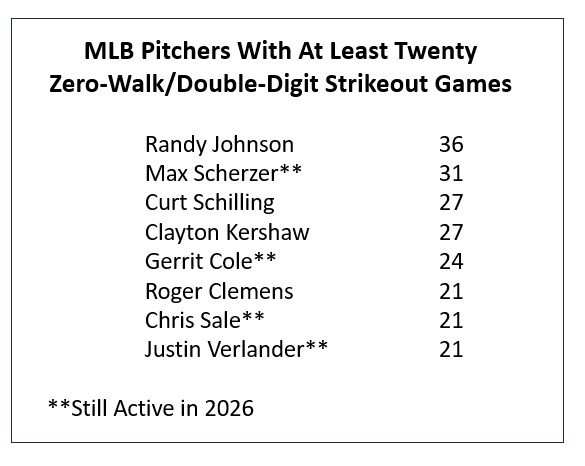
Let’s start with this chart, that shows the AL/NL Modern Era pitchers with the most double-digit strikeout openers. (All, by the way are starters, no reliever has ever recorded ten punchouts in a season opener.)

One of Those “Another Things” I Was Led To

A fun, but not super meaningful, observation for me: In 1960, as in 2026, three pitchers fanned ten or more batters in their teams’ season openers and they pitched a total of 30 1/3 innings (as opposed to this year’s three ten-strikeout openers’ 17 innings). The Senators’ Camilo Pascual fanned 15 in a nine-inning complete-game 10-1 win over the Red Sox; the Dodgers’’ Don Drysdale fanned 14 in an eleven-inning CG 3-2 win over the Cubs; and the Indians’ Gary Bell struck out 12 in 10 1/3 innings of an 11-frame 3-2 loss to the White Sox.

Perhaps more significant is that six decades later – and with the increased emphasis on strikeouts – Pascual’s 15 punchouts remains the record for a season opener. 

Now, back to our regularly scheduled blogging. Turns out, in the NL/AL’s Modern Era (post-1900), there have been a total of 86 instances (by 67 different hurlers) of a pitcher recording ten or more strikeouts in his team’s season opener. Thirty-three of those instances (38.4%) occurred in the fourteen seasons since 2012. From 2012 through 2026, there was at least one season-opener, double-digit strikeout  appearance every season and multiple such appearances in 11 seasons.  By comparison, from 2000 through 2011, there were a total of six season-opener appearances of ten or more strikeouts by a pitcher – only one season with multiple such occurrences and seven with zero.

A few other noteworthy points from 1901 through 1959, there were only ten season-opening  ten-or-more strikeout performances.  from 1971 through 1999, there were 17. There was a spike from 1960 through 1970 – 18 season-opening ten+ strikeout performances, with Bob Gibson, Mickey Lolich and Chris Short notching two each. (Keep in mind, this was the beginning of the expansion era.)

From 2012 through 2026, 7.3 percent of season-opener starts produced 10 or more strikeouts. From 1901-2011 that figure was 1.9 percent.  

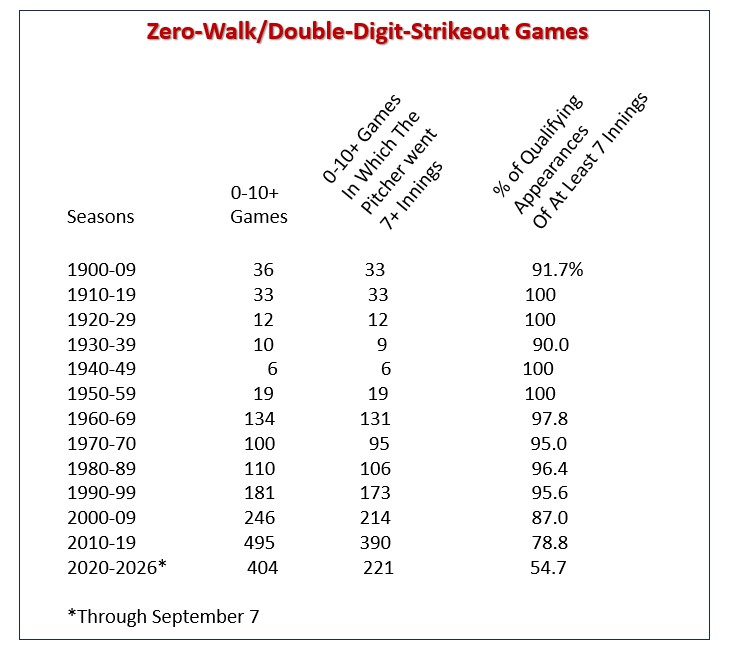
Another statistic that interested me was the fact that the starting pitchers who logged at least ten strikeouts in an opener between 2020 and 2026 averaged just 5.9 innings pitched in those appearances. By comparison, in the decade of the 1980s. the figure was 8.0 innings – and as the chart below shows that figure has been on a fairly steady decade-by-decade decline since the 1960’s.

A First For Pedro

Pedro Martinez was the first pitcher to fan ten or more batters in a season opener while pitching six of fewer innings. He notched 12 strikeouts in six innings on April 4, 2005, as his Mets lost 7-3 to the Reds. Martinez gave up three runs on three hits and two walks.

A few more tidbits.

  • The last opener featuring a complete game with ten or more strikeouts and at least eight innings pitched took place on April 8, 1991, as the White Sox’ Jack McDowell, stopped the Orioles, giving up just four hits and one run (ten strikeouts) in a 9-1 win in Baltimore. (Max Scherzer fanned 10 in a season-opening loss to the Yankees in 2020, but the game went only six innings.)
  • All of the twenty-three season-opening, ten-strikeout starts of six-innings pitched or less have taken place since 2005.
  • Two seasons have seen four pitchers notch season-opener starts of ten or more strikeouts: 1970 – Mickey Lolich, Andy Messersmith, Dave McNally; Sam McDowell; and 2023 – Dylan Cease, Logan Webb, Gerrit Cole and Shohei Ohtani.
  • Between 1960 and 1969, there were fourteen season-opening 10K+ performances – eleven of those were complete games (and one was a 10 1/3-inning, non-complete game performance). The ten-plus-strikeout performances included two extra-inning complete games  and five shutouts.
  • The last pitcher to throw a season-opener shutout with at least ten strikeouts was the Expos’ Steve Rogers in 1982 – a three-hit, two-walk, ten-strikeouts 2-0 win in Philadelphia.

Season-Opener, Complete-Game, Shutouts, with Ten Or More Strikeouts

There have been just eleven single-pitcher, seasoner-opener shutouts with ten or more strikeouts and only one player has two:  Chris Short of the Phillies.   In the 1965 opener, Short fanned eleven in a 2-0, four-hit, three-walk win over the Astros in Houston. In 1968, he fanned ten in a 2-0, four-hit, zero-walk win over the Dodgers in LA. (Both were nine-inning games.) The Philly southpaw pitched in 15 MLB seasons (1959-73), all for the Phillies. The two-time All Star went 135-132, 3.43  in his MLB career, with 88 complete games and 24 shutouts.  He was a 20-game winner in 1966 (20-10, 3.54). Others to throw season-opener shutouts with ten or more whiffs: Walter Johnson, 1917 Nationals; Lon Warneke, 1934 Cubs; Bob Feller, 1946 Indians; Juan Marichal, 1962 Giants; Bob Veale, 1965 Pirates; Bob Gibson, 1967, Cardinals; Mickey Lolich, 1976 Tigers; Andy Messersmith, 1970 Angels; Steve Rogers, 1982 Expos.

Primary Resource: Stathead.com


Baseball Roundtable – Blogging Baseball Since 2012.

Baseball Roundtable is on the Feedspot list of the Top 100 Baseball Blogs. For the full list click here

I tweet (on X) baseball @DavidBaseballRT. Follow me for new blog post notifications.

Follow Baseball Roundtable’s Facebook Page here.  


Member: Society for American Baseball Research (SABR); Negro Leagues Baseball Museum; The Baseball Reliquary.

P 1161


Baseball Roundtable Trivia(l) Tidbit Tuesday … Pinch Hit Home Run, All About Being First

It’s time again for Baseball Roundtable’s Trivia(l) Tidbit Tuesday. I hope you are enjoying this weekly presentation of baseball occurrences that for some reason caught The Roundtable’s eye.  (I’m particularly fond of unexpected performances and statistical coincidences.) These won’t necessarily be momentous occurrences, just events, statistics or coincidences that grabbed my attention. I’m also drawn to baseball “unicorns,” one-of-a-kind MLB accomplishments or statistics.

Last week, we took a long look at Tidbits surrounding MLB’s workhorses … players with 700 or more plate appearances in a season.   See that post by clicking here. This week, we’re answering a trivia question loaded with “firsts.”

Name the player, who hit:

  • The first MLB pitch he saw in, of course, his first MLB plate appearance, for a pinch-hit home run;
  • Which came in his team’s first game of the season (in other words, Opening Day);
  • Which was also the franchise’s first-ever pinch “hit” and, of course, it’s first-ever pinch-hit four-bagger; and
  • Came in the franchise’s first-ever regular-season contest.

The answer is coming right up, along with a look at the other players whose first-ever MLB plate appearance resulted in an Opening Day pinch-hit home run.

Statistical Coincidence.

The Roundtable loves coincidences. Three players have hit pinch-hit home runs in their first MLB plate appearance on Opening Day (their team’s first game of the season).  All three connected for that dinger on the first MLB pitch they ever saw.

Now, let’s answer that multi-qualifier trivia question.  The answer is:

Al Woods … Toronto  Blue Jays, April 7, 1977

Al Woods was drafted and signed by the Twins in the Second Round (secondary Phase) of the June 1972 Draft. In 1973, as a 19-year-old, he hit .302-2-10 at  for the Low-A  Geneva Twins of the New York-Pennsylvania League.  In four seasons in the Twins’ minor-league system (1973-76), he went .287-32-211, with 30 steals in 390 games.

Then – after a .284-6-74, 13-steal season at Triple-A Tacoma, he was the Blue Jays’ 15th selection in the 1976 MLB Expansion Draft – setting the stage for Opening Day 1977.  Note: The photo in the post notification/teaser (photo of  a Twins Opening Day) provided a very obscure hint in that Woods began his professional career in the Twins’ organization and played his final MLB game in a Twins’ uniform.

The Blue Jays’ first-ever game came on April 7, versus the White Sox,  in front of 44,649 fans at Exhibition Stadium in Toronto. Left-hander Ken Brett started on the mound for Chicago and the left-handed swinging Woods was on the bench for the Blue Jays.

In the fifth inning, Toronto had a 5-4 lead and righty Francisco Barrios was on the mound for Chicago (having relieved Brett in the fourth). With a runner second on one out, Woods was sent to the plate to pinch hit for right-handed swinging RF Steve Bowling. In this first-ever MLB plate appearance, Woods smacked the first pitch he saw from Barrios for a two-run home run (and a bit of a unicorn was born).  Woods stayed in the game in RF, had two more plate appearances and struck out looking both times.  (Side note: Woods was not the Blue Jays’ first-ever pinch-hitter: Jim Mason walked in a fourth-inning pinch-hit appearance. Woods’ homer , while the Blue Jays’ first-ever pinch “hit” and first-ever pinch-hit homer, was not the team’s first-ever home run. Starting 1B Doug Alt had gone deep in the bottom of the first. The Blue Jays won their inaugural game 9-5.

Woods went on to a seven-season MLB career (1977-82, 1986 … Blue Jays, Twins), hitting .271-34-196 in 618 games. His best season was 1980, when he went .300-15-47 in 109 games for Toronto.

____________________________________

The two other players who hit Opening Day pinch-hit homers in their first MLB plate appearance were Eddie Morgan (1936 Cardinals) and Chuck Tanner (1955 Braves)

Eddie Morgan … Cardinals, April 14, 1936

Eddie Morgan made his MLB debut (as a 21-year-old) with the Cardinals on Opening Day 1936 – following a 1935 .347, 13-home run season (in 112 games) with the Class-B Bloomington Bloomers. (Now, there’s an unfortunate team name.)  While he didn’t start the (home) game versus the Cubs,  Redbirds’ manager Frankie Frisch  gave the rookie a chance to play – pinch-hitting Morgan (for pitcher Bill McGee) in the bottom of the seventh, with a runner on second, no outs and Saint Louis trailing 12-3.  Morgan hit the first pitch he saw from Lon Warneke for a two-run homer to right-center. ( The Cardinals eventually lost 12-7.)

The home run would be Morgan’s only roundtripper in a two-season MLB career (1936 Cardinals, 1937 Dodgers), in which he went .212-1-8 in 39 games. While he did not play in the majors after 1937, Morgan continued to toil in the minor-leagues through the 1950 season. In all, he played 1,692 minor-league games.

Chuck Tanner, Braves … April 12, 1955

Chuck Tanner made his MLB debut on April 12, 1955 (with the Braves hosting the season opener versus  the Reds) – after a .323-20-101 season (155 games) with the Double-A Atlanta Crackers in 1954. Tanner’s might have been the most meaningful appearance among the three-players  noted in this post.  He came in with one out and no one on base in the bottom of the eighth inning (pinch-hitting for Warren Spahn), with the Braves trailing 2-1. Tanner tied the game with a home run on the first pitch he saw from Gerry Staley; and the Braves went on to win 4-2.

Tanner got in 97 games in his rookie campaign, hitting .247-6-27. (He made it to the majors at age 26, after nine minor-league campaigns … hitting .300+ in eight of them.) By the time he reached the Braves, Tanner had more than 1,000 minor-league games under his belt – playing for eight different minor-league teams at six different levels. (Tanner began his professional career as a 17-year-old.)

Tanner, an outfielder,  went on to play in eight MLB seasons (1955-62 … Braves, Cubs, Indians, Angels), going .261-21-105 in 396 games.

A student of the game, Tanner (known as  an optimistic leader … nicknamed Mr. Sunshine),  went on to a 19-season career as a major-league manager (1970-88 …. White Sox, Athletics, Pirates, Braves) – putting up a 1,352 – 1,381 record and leading the 1979 Pirates to a 98-64 regular-season record and a World Series Championship.  He also managed in the minor-leagues … 1963-70).

“The greatest feeling in the world is to win a major-league game. The second-greatest feeling is to lose a major-league game.”

                                        Chuck Tanner, July 15, 1985, Sporting News

Baseball Roundtable – Blogging Baseball Since 2012.

Baseball Roundtable is on the Feedspot list of the Top 100 Baseball Blogs. For the full list click here

I tweet (on X) baseball @DavidBaseballRT. Follow me for new blog post notifications.

Follow Baseball Roundtable’s Facebook Page here.  


Member: Society for American Baseball Research (SABR); Negro Leagues Baseball Museum; The Baseball Reliquary.

P 1160

Target Field … A Look At Some Of The Twins’ New Food, Beverage and Value Offerings

Yesterday (March 31), Baseball Roundtable took part in what has become a Roundtable rite of spring – the Twins’ annual food and beverage preview, sponsored by the Twins and Sportservice – the sports hospitality division of Delaware North.  This event features a look at (and taste of) the upcoming season’s new Target Field food and beverage offerings.

Now, there are some things I (possibly as a curmudgeon) miss about baseball seasons past; regularly scheduled, Sunday, single-admission doubleheaders; pitchers committed to completing what they started; extra-innings played by the same rules as the rest of the game;  And, I think, this season, I’ll miss those crafty hurlers with the ability to “work the edges” and expand the strike zone. Still, baseball is, in my mind, the best and most addictive of sports (for my post on the eleven reasons “Why I Love Baseball” click here).

But I digress.  I must also admit, I don’t miss the old-style baseball “menu.” As I’ve noted here before, when I first began attending MLB games, standard fare consisted of (not always piping-hot) hot dogs and (not always ice-cold) beer and soda.  For those wanting to step outside the box, there were peanuts, popcorn and Cracker Jack®.   For the really adventurous, there were frozen malt cups (with a wooden spoon after taste).  When pizza, burgers and licorice ropes arrived on the scene, we all thought baseball’s culinary landscape was complete. When helmets loaded with nachos were added, we were sure of it.

The 2026 Target Field food and beverage preview (like those that went before it ) brought home how wrong we were about reaching the ultimate in ballpark fare – and how committed the Twins are to continually raising the ballpark food and beverage (and value)  bar.

Here are a few of Baseball Roundtable’s favorite new Target Field offerings for 2026 – as judged by super-taster Bob King and me. Note:  At the time of this writing, the Twins had not yet posted prices for the new items, but they should be on Twins.com before the April 3 home opener.

NUMBER ONE

Mac and Yes Please … (Section 113)

“Mac and Yes Please” takes Macaroni and Cheese from the comfort-food category to gourmet ballpark fare. Bob I both ranked this as our number-one new offering – and you can build it to fit your own taste.  You start with a generous helping of Cavatappi pasta tossed in creamy white cheddar cheese sauce and toasted breadcrumbs. Then you choose the toppings from a list that includes:  Buffalo chicken, brisket, blue cheese crumbles, sliced hot peppers and fried onion crisps. Then, you top the whole thing off with your choice of a Buffalo ranch or BBQ drizzle.

A word of advice: Make sure you ask for the blue cheese crumbles.  As Bob noted: “That blue cheese takes this to a whole new level.“ Indeed, they do. Note: A more basic kid’s option is available.

NUMBER TWO

Wicked Corn Dogs … Section 232

Okay, what’s more baseball than a hot dog? Or what’s more Minnesota (think State Fair) than a corn dog, a hot dog encased in sweet corn meal breading and served on a stick? And could be more wickedly wonderful than enhancing those traditional favorites with spicy jalapenos or cheddar and smooth American cheese and offering it at a Twins game?   Wicked Corn Dogs start with a quality dog from Manea ‘s Meats in Sauk Rapids.  Then each dog is enhanced with jalapeno (a whole jalapeno in each dog) or a well-balanced combination of cheddar and American Cheese. Which one to choose? (Let’s work in some baseball here.) In honor of Twins’ Cy Young Award winner Frank “Sweet Music “ Viola: If you like spicy salsa music, go for the Jalapeno Wicked Corn Dog; If you prefer smooth, cool jazz, it’s the cheese version. Bob, by the way, says he intends make a Wicked Corn Dog his “opening” Opening Day snack.

NUMBER THREE

Mediterranean Bowl (Section 114)

This is a tasty and a refreshing combination of steamed rice topped with chicken shawarma (a vegetarian option is available), diced red onion, tomatoes, cucumber, feta cheese and a perfect tzatziki sauce. True Mediterranean flavors, right at the ballpark.  Perhaps the only thing better than enjoying a Mediterranean Bowl on a sunny afternoon, during a Twins game, would be enjoying one between games of a doubleheader.

ALSO IN THE MIX

Elote (from La Madres) … Section 110

A true Mexican Street Food experience – steamed corn on the cob slathered with mayonnaise and coated in a choice of cotija, Tajín or árbol spice, plus Flamin’ Hot Cheetos or hot blue corn chips, and served with lime wedges.  This is a tasty treat.  Bob and I agreed, an authentic tribute to the Mexican Street Food experience. And, hey, it’s on a stick.  We tried all three flavors – and liked them all.

—SOMETHING FOR THE SWEET TOOTH—

Justin’s Candied Popcorn Bar … Section 106

You simply can’t go wrong with anything that served in a baseball helmet, whether it’s nachos or ice cream sundaes … and especially if it’s fresh-popped popcorn complemented by your choice of toppings including Reese’s Pieces; M&M’s; crushed Oreos; chocolate-covered pretzels; yogurt-covered pretzels; Nerds clusters; cookie crumbles; miniature marshmallows; and chocolate, white chocolate or caramel sauce.  A great shareable with that special mix of salty and sweet.  The helmet full will keep two or three adults smiling.  (If you buy it for the kids, it’ll keep them busy for three to four innings, but be ready for an energetic ride home.)  Professional (well, semi-professiual ) tip, rinse out the helmet before you try it on.

Chocolate Fish on a Stick … Truly On Deck and Keeper’s Heart Town Ball Tavern

This Japanese-inspired dessert – from Minneapolis-based chef Mathew Kazama – features a fish-shaped waffle plumped with a sweet filling and served with vanilla ice cream and chocolate sauce.  It’s rich, so eat it slow – and take a picture before you bite into the fish’s tail (not sure if it’s a Walleye.)

No Gluten Way (Section 112):

There’s a new section dedicated to fans following a gluten-free diet.  Among then gluten-free offerings:

  • Beef burger with white American cheese, grilled onions, bacon and bistro sauce on a gluten-free bun;
  • All-beef hot dog with grilled onions on a gluten-free bun;
  • A variety of gluten-free snack items;
  • Tasty gluten-free cookies from Minneapolis’ family-owned Atuvava Bakery; and
  • A selection of gluten-free beers, seltzers and nonalcoholic beverages.


—BEVERAGES—

Niko Niko …. Section 120

Expanding on the successful 2025 introduction of Boba Tea at Target Field, Niko Niko expands the experience with new Boba flavors and Dirty Sodas, as well as Boozy Boba adult-beverage options .  They’ll all put a sparkle in your game day experience.

Dirty Sodas: Peachy Dew; Creamy Pepsi; Pink Cream Soda.

Boba Tea: Strawberry Lemon Fizz;  Signature Milk Tea; Hawaiian Fruit Tea.

Boozy Boba: Tequila Sunrise; Peach Palmer; Rum and Jam.

Summertime Shandies … (Several stadium bars, restaurants and clubs)

Target Field mixologists (mixologists at the ballpark, another sign of the upgrading of food and beverage offerings) have put together several flavors of this popular Midwest summer drink. (I can endorse the raspberry.)

More Mocktails …. Truly On Deck, Keeper’s Heart Town Ball Tavern, Hrbek’s)

Plenty of new, fun non-alcoholic options, themed for the baseball fan.  We particularly liked the Bullpen Breeze and Moon Shot.

—-Some VALUE-able Tips—-

Here are a few 2026 Target Field Bargains that may bring you out to the ballpark early.

  • $2 pregame beers: Available before every game for MyTwins Choice and Reserved Members 21+; and for all fans 21+ before every Friday and Saturday game (12-oz. cans of Summit Twins Pils, Budweiser and Bud Light)
  • Friday Happy Hour: Every Friday home is a party, with pre-game $2 beers, $2 hot dogs and $2 snacks, plus music from a band or DJ.
  • Free Sunday Ice Cream for the Kids: All kids 12 and under get a free ice cream at every Sunday home game, as part of Kids Day presented by Target! (Sundays also include half-price kids’ meals, presented by U.S. Bank.)
  • Tuesday Dollar Dog Day: Dollar Dogs are back, presented by Sheboygan Sausage Company.

Note: Pregame value deals are available from the time the gates open through the scheduled first pitch at select concession stands. $2 beers are available to fans 21+ with a valid ID.

So, there’s a look at some of The Roundtable’s favorites from among Target Field’s new offerings. Enjoy the 2016 baseball season and Go Twins/Go Saints!


Baseball Roundtable – Blogging Baseball Since 2012.

Baseball Roundtable is on the Feedspot list of the Top 100 Baseball Blogs. For the full list click here

I tweet (on X) baseball @DavidBaseballRT. Follow me for new blog post notifications.

Follow Baseball Roundtable’s Facebook Page here.  


Member: Society for American Baseball Research (SABR); Negro Leagues Baseball Museum; The Baseball Reliquary.

P 1159


Baseball Roundtable March?April Wrap Up … Homers, Strikeouts, Streaks and more.

It’s May 1, and that means it’s time for Baseball Roundtable’s March/April Wrap up – a look at the stats and stories that caught The Roundtable’s attention over the past month (in this case a bit more than a month), as well as The Roundtable’s Players and Pitchers of the Month, Trot Index and more.  As you might expect, given the state of the game, the highlights include a lot of home runs and a heavy dose of strikeouts.  Just a few of this month’s highlights that you will find in this post:

  • a player (Ildemaro Vargas) who collected a hit in every one of the 23 March/April games he played;
  • A pitching staff (Brewers) who fanned a record 20 opposing hitters on Opening Day;
  • 2026’s first Immaculate Inning (Mike Soroka);
  • One player (Jo Adell) making three homer-robbing catches in a single game, earning his glove a trip to Cooperstown;
  • Kenley Jansen climbing to number-three on the all-time saves list;
  • A player (JJ Wetherholt) being hit by a pitch in five straight games;
  • A manager (Alex Cora) fired after a 17-1 win;;
  • A hot line drive hit, literally, into a pitcher’s (Logan Gilbert) shirt; and
  • Much more.

Go the highlights and statistics sections section for all the stories.

Baseball Roundtable March/April Players and Pitchers  of the Month

NATIONAL LEAGUE

Player of the Month … Drake Baldwin, C, Braves

Drake Baldwin, the Braves’ 25-year-old C/DH, in just his second MLB season, has opened some eyes in Atlanta and around MLB. Baldwin put up a .308-7-25 line in March/April and also tied for the NL lead in runs scored (30) and for the lead in base hits (40). He was, in fact, one of only three MLB players with 25 or more run scored and 25 or more RBI for March/April.  A “25-25” start to the season is quite an accomplishment. In fact, if you lower the bar to 20+ runs and 20+ RBI, you still find only 16 2026 qualifiers.

Baldwin, in fact, scored in 24 of 20 March/April games and had two four-RBI contests. He collected hits in 25 March/April games and had multiple in 13. Baldwin, in fact, never went two consecutive games without a hit.

Baldwin was a third-round pick in the 2022 MLB Draft, out of Missouri State University, where he hit .317-24-105 in three seasons (120 games). In three minor-league seasons, he went .272-32-158 in 257 games and, in 2025, he hit .274-19-80 in 124 games for the Braves.

Honorable Mentions: Reds’ 22-year-old 1B Sal Stewart (like Baldwin in his MLB second season) got out the blocks fast, with a .281-9-29, line (with 20 runs scored).  His 29 RBI led MLB. Reds’ SS Elly De La Cruz cruised in at .282-10-24, with 26 runs and the added bonus of eight steals. Miami C Liam Hicks put up a .315-7-28 line  (second only to Stewart in RBI) and Braves’ veteran 1B Matt Olson went .296-9-28, with 27 runs scored. Finally, there is Diamondbacks’ 1B Ildemaro Vargas, who went .378-6-20 in 23 games (his .378 average leading all players with at least 75 at bats.) Vargas, notably, had at least one hit in every March/April game he played. More on Vargas in the Surprise Player of the Month section.


Pitcher of the Month … Shohei Ohtani, RHP, Dodgers

This was a tough one.  You had the likes of the Braves’ Chris Sale and Giant’s Landen Roupp, each with an NL-topping five March/April wins, the Brewers’ Jacob Misiorowski with a NL-leading 51 strikeouts in just 32  2/3 innings; the Dodgers’ Shohei Ohtani with an MLB-lowest (among pitchers with at least 25 March/April innings) 0.60 earned run average; and the Padres’ Mason Miller with an MLB-topping  ten saves (in ten opportunities) and 29 punchouts in 15 1/3 innings.

Wow! Where to go with this one.?  I went with Ohtani.

Consider, while Ohtani was only 2-1, you can’t ignore his MLB-best (among pitchers with at least 25 innings pitched) 0.60 earned run average. The guy gave up just two runs in five starts (30 innings) and he fanned 34 batters (nine walks). His 0.87 WHIP was fourth in the NL (among pitchers with at least 25 innings) and his .160 average against third.  As far as the lack of wins, you can’t blame Ohtani. In  his five starts, the Dodgers plated just six runs while he was in the game. (I gave him extra credit for pitching under pressure.)

The fact is, you can make a strong case for any of the Honorable Mentions as well.

Honorable Mentions: Already mentioned these near misses in the first paragraph: the Padres’ Mason Miller, who could easily have been part of a three-way tie (1-0, 1.17 with ten saves in ten opportunities and 29 strikeouts versus just three walks, in 15 1/3 innings); Giants’ Landen Roupp (5-1, 2.55 in six starts); Dodgers’ Jason Wrobleski, a surprise 4-0, 1.50 in five appearances/four starts;  and Braves’ veteran Chris Sale, 5-1, 2.31 in six starts, who gave up more than one run in only one of his six outings and who fanned 38 batters and walked just nine (35 innings).

AMERICAN LEAGUE

Pitcher of the Month – Jose Soriano, RHP, Angels

Photo: Sewageboy, CC BY-SA 4.0 <https://creativecommons.org/licenses/by-sa/4.0>, via Wikimedia Commons

This was a bit easier the the NL considerations. Earned Run Average is that bright and  shiny thing that always gets The Roundtable’s attention.  Couple it with victories and you have a Pitcher of the Month formula. Angels’ righty Jose Soriano’s March/April performance fit that twin bill.  Soriano put up a 5-1  in seven March/April starts – tying for the most wins in MLB.   And, his stingy  0.84 ERA was lowest among AL pitchers with at least 25 innings pitched (second only to Shohei Ohtani in MLB.).  In 42 2/3 innings (fifth-most in the AL), he gave up just 24 hits and 16 walks, while fanning 49 batters (tied for second-best in the AL).  Among pitchers with at least 25 innings pitched, His WHIP of 0.94 was fifth-best in the AL and he held batters to a .164 average (second-lowest among AL pitchers with at least 25 innings pitched). The 27-year-old’s emergence is a bit of a surprise.  In three previous MLB seasons (91 appearances/51 starts), he had been 17-21, 3.89.

In his seven starts this season, Soriano has given up zero earned runs in five.  His best game came on April 6 versus the tough Atlanta Braves, as Soriano went eight innings, giving up three hits and no runs, while fanning ten and walking none.  (Extra credit here, in that he went 5-1 for a Angels’ squad that went 12-20.)

Soriano is also a “good story,”  given the  challenges he has faced in his pro career. He was signed as an International Free Agent, out of the Dominican Republic, in March of 2016.  After showing some promise, but not rising above A-Ball, he underwent Tommy John Surgery in February of 2020 and was later taken (from the Angels) by the Pirates in the 2020 Rule Five Draft. In the Pirates’ system, he pitched just two games (High-A) before suffering another injury and undergoing his second Tommy John Surgery (June of 2021). In November of 2021, he was returned to the Angels and, after a rehab period, resumed his career at Single-A. Shortening up a long story,  Soriano showed swing-and-miss stuff and was promoted to the Angels  – as a reliever – in June of 2023 (3.64 ERA and 56K in 42 innings in 38 appearances for the Halos).  He was back in a starting role with the Angels in 2024 and was 6-7, 3.42 (22 games/20 starts/97K in 113 innings) before being put on the 60-day IL in early September.  He had a less eventful 2025, going 10-11, 4.26 in 31 starts (152K in 158 innings).  And that brings us to his remarkable 2026 early-season performance

Honorable Mentions:  Gotta like Yankees‘ 25-year-old righty Cam Schlittler, 4-1, 1.51 (ERA second only to Soriano among AL pitchers with 25 innings).  In seven  starts, he fanned 49 and walked just six in 41 2/3 innings. His  0.74 WHIP is the lowest among AL pitchers with at least 25 March/April innings and he held hitters to a .168 average. A shoutout also goes to Peter Messick of the Guardians, 3-0, 1.73 with 38K in 36 1/3 innings; the Guardians’ Gavin Williams (5-1, 2.70 in seven starts, with a league-leading 53 strikeouts; and the Yankees’ Max Fried, 4-1, 2.09 in seven starts, with a league-topping 47 1/3 innings pitched (0.80 WHIP, .161 average against).

Player of the Month… Yordan Alvarez, DH, Astros

Flickr user thatlostdog–, CC BY 2.0 <https://creativecommons.org/licenses/by/2.0>, via Wikimedia Commons

It’s rare that the Roundtable picks a primary DH as Player of the Month, but the Astros’ Yordan Alvarez earned it with a truly a dominant March/April at the plate. Alvarez had the second-highest batting average among MLB players with at least 25 March/April at bats at .356.  He led MLB in hits (42); was tied for first  in home runs (12); was fourth in RBI (27); and scored 25 runs. Alvarez led all MLB players with at least 75 at bats in slugging percentage (.737) and was first in on-base percentage (.462). Alvarez drew 21 walks (versus just 14 strikeouts. His month included  a 13-game hitting streak (April 14-28), during which he hit .389-5-12. Overall,  he collected hits in 25 of 31 games; and multiple hits in 14.

Honorable Mentions: Diamondbacks’ Ildemaro Vargas, a lot more on Vargas in the Surprise Player of the Month section.  Suffice here to just to say he posted  .378-6-20 line, with a 23-game hitting streak. Vargas was edged out by Alvarez due the latter’s HR, RBI and runs scored advantage. Also recognized zed are Yankee 1B Ben Rice, who went .327-10-23, with 26 runs scored; and the Angels’ Mike Trout, who hit just .248, but drew 32 walks (.431 OBP), smacked  ten homers, drove in 21 runs and scored an 29.


Surprise Player of the Month … Ildemaro Vargas, 2B/3B/SS, Diamondbacks

This one should be subtitled “For The Love Of The Game.

Ildemaro Vargas is a true journeyman, utility player, in his first nine MLB seasons 2017-25 … Diamondback, Nationals, Cubs, Twins , Pirates), he appeared in 174 games at 3B, 145 at 2B, 48 at SS, 29 in LF, five on the mound and two in RF; plus 104 games as a pinch-hitter, 14 as a pinch-runner and seven as a DH. In 2021 alone, he took the field for the Cubs, Pirates and Diamondbacks.

In those first nine MLB seasons, he appeared in an average of 51 MLB games per season, never reaching 100 games.  (In seven of those nine, he also spent time in the minors). Over those nine seasons, Vargas hit .249-20-145 over 458 games.  Side Note:  Vargas also has a dozen seasons in the Venezuelan Winter League on his baseball resume.

This season, Vargas is off to a .378-6-20 start (with his average leading all MLB qualifiers).

Further, he has yet to go a game without a hit.  Let me key that again, he has played 23 games in March/April and  has at least one hit in each of them.  He also collected hits in his last three games of 2025, giving him an active 26-game hitting streak. And, true to his history, this season, he has appeared at 1B, 2B, 3B,SS,  LF and DH. DH

This is a true surprise and a great feel-good story. (Oh, for those who like to know such things, the longest season-opening hitting streak belongs to the Tigers Ron LeFlore at 30 (1976).

__________________________

THE TROT INDEX … A REGULAR BASEBALL ROUNDTABLE FEATURE

Through April 30,  35.8% of the MLB season’s 35,655 plate appearances ended in a trot (back to the dugout, around the bases, to first base). We’re talking about strikeouts, home runs, walks, hit by pitch and catcher’s interference – all outcomes that are, basically, devoid of action on the base paths or in the field. Here’s the breakout: strikeouts (22.2%); walks (9.6%); HR (2.8%); HBP (1.1%); catcher’s interference (less than 1%). 

The 35.8% is up slightly from  the 35.0% through April in 2025, when the figure were:  strikeouts (22.1%); walks (9.0%); home runs (2.8%); HBP (1.0%); catcher’s interference (less than 1%). I’ve  also looked into full-year Trot Index figures for the years I have been a fan: 30.3% in 2010; 29.9% in 2000; 31.7% in 1990; 23.1% in 1980; 27.0% in 1970; 25.1% in 1960; and 22.8% in 1950.

_________________________________________


If the season ended May 30, your playoff teams would have been:

          AL:  Yankees, Athletics, Guardians. WC: Rays, Mariners, Tigers.

          NL: Braves, Dodgers, Reds.  WC: Padres, Cubs, Cardinals.

A few observations:

  • As of close of play April 30, the AL Central, without a single team over .500, would have two teams in the post-season; the same number as the NL Central, which did not have a single team under .500.
  • The Dodgers, with MLB’s highest payroll (per Sports Illustrated) are 20-11, in first place in the NL West.  The Mets, with MLB’s second-highest payroll,  are 10-21 (MLB’s worst  through April).
  • Four teams had at least 20 wins through April 30.The Yankees, Braves, Dodgers and Reds.  The first three are in the top nine in terms of salaries (third, eighth and first, respectively), the Reds are number-19.
  • The Reds lead the NL Central with a 20-11 record, despite a negative-three run differential, having been outscored 136-133 in March/April.  Three of the seven division leaders (one tie) have a negative run differentials:  Guardians (-8); Athletics (-5); Reds (-3).
  • The largest positive run differential is a plus-66, by both the Dodges and Braves, The largest negative run differential belongs to Phillies at minus-45.
  • The Nationals are not keeping the home crowds happy. There are 12-7 on the road, but 3-10 at home.
  • The Astros lead the AL in runs scored, but are 12-20 on the season.

Seeing Red, Rooting Red

Of special interest to me are the Reds, with a negative-three run differential, but a 20-11 record.  The three other teams with 20 or more wius have run differentials of +66 (Dodgers and Braves) and +47 (Yankees).  How are the Reds doing it – and can it be sustained?  First thing I noticed is that they have MLB’s best record in one-run games – a clean 7-0, as well as in extra-innings (3-0). They also have played just three games against teams over .500, 18 games against AL teams and only three games within their own division.  It looks like a challenge, but they have some interesting pieces and I’ll be rooting for them.

The offense, so far, has really gone through SS Elly De La Cruz (.282-10-24, with eight steals) and C Sal Stewart (.281-9-29).  Those two have driven in 39 percent of the Reds’ runs, scored 38 percent and knocked 45 percent of the team’s home runs.  They can expect some help from  DH Nathan Lowe (thus far .288-5-12) and LF Spencer Steer (.237-5-10), but they will need more balance on offense. DH/3B Eugenio Suarez – sidelined with an oblique issue –  has 328 homers on his resume (13 seasons) and, if he returns and heats up,  it could add depth to the lineup.

The Reds are missing sidelined starters  Hunter Greene (elbow surgery) and Nick Lodolo (blister)To this point, Chase Burns (3-1, 2.65) in six starts and Rhett Lowder (3-1, 3.18  in six starts) are leading the pitching, but the remainder of the rotation – Andrew Abbott, Brady Singer and Brandon Williamson have ERAs of 5.97, 4.97 and 6.11 as we enter May. (Williamson is now also on the IL).  Lodolo (9-8, 3.33 a year ago) is expected back soon and should strengthen the rotation.   The bullpen has been a strength  – particularly Graham Ashcraft (1.20 ERA in 15 games), Connor Phillips (2.04 in 16 games) and Brock Burke (0.63 in 15 games) and has played a major role in the Reds’ ability to win close games.  Closer Emilio Pagan has had some early struggles, perhaps tied to hamstring issue. If he ends up on the IL, Reds fans will likely see some new arms from Triple-A.

Overall, a lot will have to go right and some players will have to get healthy for the Reds to remain “in the hunt.”  Probably not in the cards over the long seasons, but hey have shown some grit to this point and they should be exciting/interesting to watch (think Elly De La Cruz).

——-Team Statistical Leaders March/April 2026 ———-

RUNS SCORED

National League – Braves (177); Nationals (175); Cubs (169)

American League – Astros (168); Twins (154); Yankees (153)

The fewest runs in March/April were scored by the Giants (104). In the American League, it was the Rangers (120).    

AVERAGE

National League – Dodgers (.273); Braves (.271); Cubs (.261)

American League – Astros (.265); Rays (.250); Tigers (.250)

The lowest team average for March/April belonged to the Reds at .220 – the White Sox were at the bottom of the NL at .225.

HOME RUNS

National League – Dodgers (45); Braves (43); Cubs (42); Reds (42)

American League – Yankees (48); Angels (42); Astros (40)

The fewest home runs in March/April were hit by the Giants (19). In the American League, it was the Red Sox, at 21. 

TOTAL BASES

National League – Braves (495); Dodgers (474) ; Cubs (457)

American League – Astros (482); Tigers (438); Yankees (430)

The Dodgers led MLB in March/April Slugging Percentage at .452. The Astros led the AL (.438)

DOUBLES

National League – Braves (61); Rockies (61); Diamondbacks (55)

American League – Astros (66); Tigers (62); Guardians (54)

TRIPLES

National League – D-backs (10); Marlins (8); Phillies (7)

American League – White Sox (6); Rays (5); Royals (5); Tigers (5)

 STOLEN BASES

National League – Brewers (36); Marlins (36); Nationals (32)

American League – Rays (34); Yankees (32); Rays (29); Twins (26)

The Giants stole the fewest sacks in March/April  at eight – in 12 attempts.  The Tigers stole the fewest bags in the AL – nine in 13 attempts.  

WALKS DRAWN

National League – Brewers (142); Cubs (141); Reds (128)

American League – Yankees (138); Angels (135); Twins (134)

The Cubs led MLB in March/April on-base percentage at .353. The Astros led the AL at .346. The Mets had MLB’s lowest March/April  OBP at .289.  The Red Sox anchored the AL at .309. 

BATTER’S STRIKEOUTS

National League – Pirates (306); Rockies (304); Reds (286)

American League – Angels (314); White Sox (290); Mariners (288)

Blue Jays’ batters fanned the fewest times in March/April (210). The D-backs fanned the fewest times in the NL at 240.

__________________________________________________

EARNED RUN AVERAGE

National League – Braves (3.12); Dodgers (3.19); Brewers (3.74)

American League – Yankees (3.11); Rangers (3.47); Mariners (3.67)

The Astros had the highest March/April ERA at 6.08.  The Nationals had the highest ERA in the NL at 5.08.

STRIKEOUTS

National League – Pirates (301); Phillies (291); Mets (289)

American League – Guardians (297); Blue Jays (294);  Astros (293);

The Blue Jays averaged an MLB-best 9.60 strikeouts per nine innings in March/April. The Phillies averaged an NL-best 9.51.  Eight teams averaged nine whiffs per nine or better.

FEWEST WALKS SURRENDERED

National League –   Cubs (94); Dodgers (97); Phillies (98)

American League – Mariners (80); Yankees (85); Rangers (96)

The Mariners walked an MLB-lowest 2.53 batters per nine innings in March/April.  The Astros walked an MLB-worst 5.66 batters per nine frames.

SAVES

National League – Padres (12); Braves (11); Cardinals (11)

American League – Rays (12); Athletics (11); Orioles (10); White Sox (10)

The Nationals  blew the most saves in March/April  – ten (in 17 opportunities).  The Astros had just one blown save in 7 opportunities.  

Walks + Hits/Innings Pitched (WHIP)

National League – Dodgers (1.12); Braves (1.16); Cubs (1.19)

American League:  Yankees (1.14); Rangers (1.21); Guardians (1.23)

Bonus Stats:

  • The Nationals gave up an MLB-high 52 home runs in March/April. The Padres gave up an MLB-low 35 home runs.
  • Dodgers’ pitchers held opponents to an MLB-low .210 average in March/April. The Phillies’ staff was touched for an MLB-high .280 average.
  • The Mariners’ strikeouts-to-walks ratio for March/April topped MLB at 3.23. The Astros had MLB’s worst ratio at 1.67.

—–2026 MARCH/APRIL HIGHLIGHTS—–

A “Home “Opener

The 2026 MLB season opened at 5:05 p.m., Wednesday,  March 26 in front of approximately 41,000 fans in San Francisco’s Oracle Park. March still seems a tad early, but there were some positives for me.  I was happy to see the National Pastime open with a game that took place in a true “home” ballpark.  As regular readers know, The Roundtable has never been fond of those “overseas” season openers, held in sports facilities where neither team is really the “home” squad and usually several days before the rest of MLB starts playing games that count. Score one for MLB (with me) on this one.

A few highlights and lowlights. The Yankees rocked the hometown Giants 7-0 (a highlight or lowlight depending on your allegiance). The first strikeout of the season can be credited to the first batter of the season. Giants’ starter Logan Webb fanned Yankee leadoff hitter CF Trent Grisham to open the game.  (Webb also fanned Yankee number-two hitter RF Aaron Judge, which proved to be more of a sign for what Judge would do than what Webb would accomplish.  (After his 1-2-3, two-strikeout first inning of the season, Giants’ ace Webb went on to last just five innings and gave up nine hits and seven runs – six earned – although he did fan seven.) Yankee slugger Judge struck out four times before putting the ball in play for a ninth-inning 5-3 groundout.)
Aaron Judge was the only member of the Yankee lineup to go hitless on Day One.

The first hit of 2026 went to Giants’ DH Rafael Devers (first-inning single); the first run scored to Yankees’  DH Giancarlo Stanton in the second inning (when the Bronx Bombers plated five runs versus Webb); the first RBI to Yankees’ SS  Jose Caballero, who plated Stanton with a second-inning single. There were no home runs in the game. In fact, 12 of the games’ combined 13 hits were singles (Grisham had a second-inning, two-run triple.) Webb of course, took the first loss of the season. Max Fried, who went 6 1/3 scoreless frames got the first win, and there was no save.
Let’s Get This Party Started … Two-for Two

In the season’s first week, we saw a pair players  go deep twice in their first-ever MLB regular-season game.

On March 26, Guardians 24-year-old rookie RF Chase DeLauter, batting second in his first regular-season MLB appearance (focus on the term “regular-season,”  it  will come into play), gave the Guardians a quick lead – homering (solo shot off the Mariners’ Logan Gilbert) in the  first inning. In the process, he joined the more than 140 players who have  gone deep in their  first MLB regular-season at bat. Then, in the ninth inning, DeLauter book-ended the  game and moved into more rarified air, adding a second solo homer (off Cooper Criswell) to join just six players to homer twice in their debut regular-season game.  Overall, DeLauter was three-for-five, with three runs scored and two RBI on the 6-4 Cleveland road win.

Why the regular-season modifier?  DeLauter actually made his MLB debut in last season’s AL Wild Card Series, going one-for-six in two games against Detroit (becoming just the seventh player to make his MLB debut in a post-season contest).

DeLauter  was a first-round pick (16 overall) in the 2022 MLB Draft, out of James Madison University  (where he hit .402-15-70 in three seasons (66 games). In three minor-league campaigns (138 games), he hit .302-20-87 .

Chasing a Good Story

Chase DeLauter hit four home runs in his  first three games (March 26-28) – going .357-4-5 in that span –  and joining Trevor Story (2016 Rockies) as one of two players to homer four times in their first three MLB regular-season games). DeLauter went one-for-three (a single) in his fourth game. That provided a bit of historic separation for Story, who  homered twice in his fourth MLB game (making him the only player with six long balls in his first four MLB games … #InBaseballWeCountEverything.) DeLauter ended April at .257-5-18.

On March 31, Diamondbacks 22-year-old rookie 3B Jose Fernandez (called up to replace and injured Pavin Smith)  also went deep twice in his MLB debut.  Fernandez, batting in the number-six hole, singled (off the Tigers’ Casey Mize) in the bottom of the second; hit a solo homer to left off Mize in the fourth; struck out (off Drew Anderson) in the seventh; and, in the eighth, hit a three-run homer to left-center (off Tigers’ closer Kenley Jansen) to give Arizona a 7-5 lead (which proved to be the final score).

The other six players to poke a pair of long balls in their first regular-season games were (per Elias Sports Bureau): Charlie Reilly (1889 Columbus Solons); Bob Nieman (1951 St. Louis Browns); Bert Campaneris (1964 Kansas City Athletics); Mark Quinn (1999 Kansas City Royals); J.P. Arencibia (2010 Toronto Blue Jays); and Trevor Story (2016 Colorado Rockies). Story is the only one of those who, like DeLauter, accomplished the feat on Opening Day.

Give Me Five, Mate, Okay, I’ll Take Four

Tigers’ 21-year-old rookie 3B Kevin McGonigle collected four hits in his March 26 (Opening Day) MLB Debut, just one hit shy of the all-time record for an MLB-debut outing and tying the record for an MLB-debut on Opening Day.

McGonigle hit a two-run double on the first major-league pitch he ever saw  (from the Padres’ Nick Pivetta in the top of the first). He doubled (again off Pivetta in the third); singled (off Ron Marinaccio) in the fifth; popped out to third (off Bradgley “Yes that how you Spell It” Rodriguez) in the seventh; and singled in the ninth (off Wandy Peralta.)

McGonigle was signed the first Round of the 2013 MLB Draft (37th overall), out of Monsignor Bonner and Archbishop Prendergast High School in Pennsylvania). In the minor leagues, including Fall League, he hit .313-3-149, with 45 steals (202 games).  The 21-year-old ended April at .328-2-13.

Two-for-Five

Two players have collected five hits in their major-league debuts: Fred Clarke of the 1894 Louisville Colonels (nine innings) and  Cecil Travis of the 1933 Nationals (12 innings). 

One For The Record Books

Photo: Drovetochicago, CC BY-SA 4.0 <https://creativecommons.org/licenses/by-sa/4.0>, via Wikimedia CommonsOn March 26, Brewers’ flame-throwing righty  Jacob Misiorowski got his first Opening Day Start – and he made the most of it.  Misiorowski, popularly called “The Miz”, fanned 11 White Sox batters in just five innings to set a new Brewers’ Opening Day high for Ks.  After giving up a home run to the first batter he faced in the 2026 season (White Sox 2B Chase Meidroth), Misiorowski fanned the numbers two, three and four hitters (SS Colson Montgomery, 3B Miguel Vargas and DH Andrew Benintendi) in succession. He fanned two more in the second; two in the third; three in the fourth and one in the fifth.

And The Miz wasn’t the only one having a good day in Milwaukee. The four relievers who followed Misiorowski to the mound added another nine strikeouts in their four innings – tying the MLB record for total strikeouts in a nine-inning game.  AND, the Brewers’ lineup contributed 12 hits  and 14 runs) as the Brew Crew triumphed 14-2 in front of 43,001 ecstatic fans (at least I think most were ecstatic).

Side Note: One April 25, Misiorowski started against the Pirates (in Milwaukee) and (as Ebby Calvin “Nuke” Laloosh, would have said ) “announced his presence with authority” early on. He fanned the first batter of the game, Pirates’ CF Oneil Cruz, on a 1-2 102.7 MPH four-seam fastball.  It was the fastest pitch for a strikeout by a starter since tracking began in 2008. “InBaseballWeTrackEverything.”

Do You Remember?

Jacob  Misiorowski made his MLB debut, as a 23-year-old,  on June 12, 2025.  At the time, he was 4-2, 2.13 at Triple-A Nashville, with 80 strikeouts (31 walks) in 63 1/3 innings.  With the Brewers, he  immediately began lighting up radar guns. His first two MLB pitches were clocked at 100.5- and 101.8-mph. In his first start, he reached triple-digits (100-mph or better) on 14 pitches. Next time out, he threw 29 triple-digit heaters over six-plus frames (he faced two batters in the seventh) – and he didn’t surrender a hit over his first 11 MLB innings.

In his first five MLB outings, Misiorowski went 4-1, 2.81, with 33 strikeouts in 25 2/3 innings.  Then came some startling (to some) news. On July 12, MLB announced that Misiorowski was going to join the NL All Star squad (as a replacement for the Cubs’ Matthew Boyd) for the July 15 All Star Game. It was the fewest number of games played  ever for an All Star selection … and there were those who maintained the honor should have gone to a more experienced hurler. 

The Miz, however,  shook it off – and didn’t disappoint. He pitched the eighth inning of the All Star Game, facing four batters (one single, three flyouts) and threw nine of his 18 pitches at 100+mph, the fastest at 103.3-mph.  He finished the 2025 season at 5-3, 4.36, with 87 strikeouts (33 walks) in 66 innings pitched. 

Blue Jays’ Kevin Gausman Rolls an Opening-Day Eleven

The Blue Jays opened the 2016 season at home against the A’s, with ace Kevin Gausman on the mound – and, like Jacob Misiorowski (above), he brought his A-Game to the A’s. Gausman went six innings, giving up one  hit and one run (a fourth-inning home run by A’s C Shea Langelier). Over his six frames, he also fanned eleven batters – setting a new Blue Jays’ record for strikeouts on Opening Day., Gausman, however, did not get the win (the Blue Jays triumphed 3-2, on a walk-off RBI single by SS Andres Gimenez with two out in the bottom of the ninth).

Langelier, by the way, drove in (and sored) both A’s runs – on a pair of Opening Day, solo homers; becoming just the fourth A’s player with a multi-homer Opening Day (Jason Giambi, 2000, two homers); Khris Davis, 2017, three homers); Tyler Soderstrom, 2025, two homers). Langeliers is coming off a solid .277-31-72 seasons in 2025 – and was .328-8-15 at the end of April

Mariners Going For a Little Extra

Over their first two games of the 2026 season, the Seattle Mariners collected nine hits and nary a single – becoming the first team in the Modern Era to go through the first two games of the season without a single single, and just the ninth team to have zero singles over any two-game span. Over those two contests (which they split), Mariners’ batters delivered two doubles, one triple and six home runs. The Mariners finally collected their first single of the season on March 28, in the third inning of their third game (Cal Raleigh) … their eleventh hit of the new season.

A Perfect Ten

Nationals’ outfielder Joey Wiemer (who came into the season with a career .205 MLB batting average … in 448 at bats over three seasons) got off to a pretty good start in 2026.

  • On March 26, he went home run, walk, single, single as the Nationals topped the Cubs 10-4;
  • On March 27, he did not play, as the Nationals lost to the Cubs 2-10;
  • March 28, back in the lineup, Wiemer went home run, triple, walk, single in a Nats’ 6-3 win over the Cubs;
  • On March 29, it was single, single, groundout, flyout, walk in a 13-2 win over the Phillies.

If you look closely that those results, you will see that Wiemer reached base safely in his first ten plate appearances of the 2026 season.  That tied Carlos Delgado (2002) for the most consecutive plate appearances to reach base safely to start a season in the live-ball ERA (since 1920). Yes, again in baseball we count everything, and also accept many qualifiers.

Celebrating 50 with 50

The Blue Jays are celebrating their franchise’s 50th Anniversary and they got off to a pretty good start. They opened the season, with a three-game, home-field sweep of the A’s (3-2. 8-7 and 5-2 on March 27,28 29). In the process, Blue Jays’ hurlers fanned fifty batters over the three games – the most strikeouts recorded by an MLB team in its first three games of a season EVER.  In the first game, four Blue Jays pitchers recorded 16 strikeouts (led by starter Kevin Gausman’s 11 in six innings). In Game Two, an 11-inning affair, eight Blue Jays hurlers recorded 19 strikeouts (led by starter Dylan Cease’s 12 in 5 1/3 innings); In Game Three, five Blue Jays’ moundsmen fanned 15 batters (led by starter Eric Lauer’s nine in 5 1/3 innings).

Happy Birthday To Me

March 28, was Dodgers’ C Will Smith’s 31st birthday. It was also the night the Dodgers were handing out bobbleheads celebrating Smith’s go-ahead homer in Game Seven of the 2025 World Series. Keeping with what seems to be a power theme in 2026 (homers and strikeouts), Smith celebrated in style. Popping an eighth-inning, two-run, go-ahead home run that provided the margin in a 3-2 Dodgers’ win over the Diamondbacks.

2026’s First Immaculate Inning

On March 30, the Diamondbacks picked up their first win of the new season – a 9-6 triumph over the Tigers. In the top of the fifth inning of that game, with the Diamondbacks already up 5-0, D-backs’ starter Mike Soroka gave the fans an extra “treat” – tossing the first Immaculate Inning (three-up, three-down, nine pitches, three strikeouts) of the 2026 season. Soroka’s victims were Tigers’ 9-1-2 hitters (SS Javier Baez, RF Kerry Carpenter, and 2B Gleyber Torres). All three went down swinging. In keeping with 2026’s early theme of strikeouts and home runs, Soroka tied his career high for strikeouts in a game, fanning ten in five innings (four hits, one walk, no runs).

You Fellas Catch On Fast

The first 2026 MLB Player of the Week awards (for March 25-29) went to Guardians’ OF Chase DeLauter and the Reds’ 1B Sal Stewart. Not only were they both from Ohio-based teams, their recognitions marked just the second time that a pair of rookies won a season’s inaugural Player of the Week Awards (after the Rockies’ Trevor Story and Astros’ Tyler White in 2016).

DeLauter went 6-for-17 (.353) with four home runs, five RBI and five runs scored in four games. Stewart went 7-for-10 (.700), with a home run, three doubles, two runs scored and two RBI in three games.

The International Game

From March 30 through April 1, the Dodgers starting pitcher were Roki Sasaki, Shohei Ohtani, and Yoshinobu Yamamoto. See a pattern here? Elias Sports Bureau reports that it’s the first time an MLB team has started Japanese-born pitchers in three consecutive games. More #InBasebvallWeCountEverything.

April Fool’s Day, Appropriately

April 1 saw the first MLB game to end on a challenging note – a strikeout produced by the new ABS challenge process. (Fortunately, it was not a one-run ball game.) It happened with the Texas Rangers at bat in the bottom of the ninth inning, with two outs, no one on base, Texas down 8-3 and Rangers’ CF  Evan Carter facing the Orioles’ Albert Suarez.  Suarez delivered a high fastball to Carter on a 1-2 count. The pitch was originally called a ball by home plate umpire Manny Gonzalez, but Orioles’ catcher Sam Basallo challenged the call and, upon review, the pitch was ruled not high, but high in the zone, for a game-ending strikeout.  Side note:  The Roundtable is not a fan of the challenge system.

Wow, I Thought It Would Be Harder Than This

Giants’ 24-year-old  rookie catcher Daniel Susac made his first MLB plate appearances on April 2 (he did play three innings behind the plate on April 1). Here’s how his plate appearances on April 2 went: leadoff single in the second; single in the third; walk in the fifth; single in the seventh. His next plate appearances came on April 7, and he delivered another single in the second inning; another single in the fifth. Finally, in the seventh inning of that contest, he flied out to right.  But in his first six MLB plate appearances: five singles and a walk. That singles him out for an appearance in these highlights.

Susac finished April at .478-0-5 in 11 games.  In 2025, at Triple-A Las Vegas, he was .275-18-68 in 97 games.

The Home run That Was … Three That Weren’t … A Sweet Adell-line

As the Angels faced off against the Mariners (in Seattle) on April 4, Angels’ SS and  leadoff hitter Zach Neto got them off to a good start. Neto homered on the third pitch of the game (an 0-2 pitch  from Mariners’ starter Emerson Hancock) in the bottom of the first to give LA a 1-0 lead. That lead held up for a 1-0 Angels’ win, thanks to a sweet show by Angels right-fielder Jo Adell. Adell went high above the RF wall – and even into the right field stands to rob the Mariners not just of one, or two, but three home runs.

In the first frame, it was a leaping catch above the home run marker on the right field wall to rob Seattle C Cal Raleigh of a home run. In the eighth, another Adell leaping grab at the limits of the outfield, took a home run away from 1B Josh Naylor.  Then, Adell topped it off, with a ninth-inning catch, on a long fly off the bat of SS J.P. Crawford that ended with Adell, ball in glove, clearing the lower wall near the RF foul pole and  landing among the  fans in the right field seats. Three Adell robberies and — Game, Set , Match.

In an MLB.com article, Jared Greenspan reports that , after the game, Angels’ Manager Kurt Suzuki termed the contest “The Jo Show’ and Angels’ Special Assistant Torii Hunter (himself a nine-time Gold Glover and master of the home-run steal) termed it “the greatest defensive game I’ve ever seen.”

How big of a deal was this? The glove Adell used in his Tri-Way Robbery is now at the Baseball Hall of Fame in Cooperstown.

Bullpen By Committee, Indeed

From April 6 through April 9, the Twins put together a four-game winning streak. Now, that’s not exactly highlight-worthy.  What is,  however, is the fact that over that time, they recorded four saves – each by a different pitcher (and, in each case, it was their first save of the season).  It started with an April 6, 7-3 win over the Tigers (in Minnesota), with Cody Lawyerson  going 1 2/3 scoreless innings for his first career save. On April 7, the Twins topped the Tigers 4-2, with the save going to righty Justin Topa (2/3 of an innings, also scoreless). Then, on April 8, the Twins topped Detroit 8-6, with the save going to Kody Funderburk (Topa and Lawyerson also pitched in that game). Funderburk, like Topa, pitched 2/3 of an inning (scoreless).  On April 9, it was Eric Orze’s turn, and he pitched one scoreless frame, getting the save, as the Twins topped the Tigers 3-1.

More #InBaseballWeCount(andtrack)Everything

On April 10, the Dodgers’ 3B Max Muncy muscled LA to an 8-7 win over the Rangers (in LA). Muncy went four-for-five, scored four runs and drove in three. His hits included a solo homer in the second inning; a solo home run in the fourth; and a walk-off solo homer, on an 0-2 pitch, with two outs in the bottom of the ninth. (That last one had to be a shocker to the Rangers. Reliever Jacob Latz had come in and fanned C Will Smith and 1B Freddie Freeman, before getting Muncy down 0-2.) Post-game reports from the Elias Sports Bureau indicated that only one other Dodger has had a three-homer game that included a walk-off shot:  CF Don Demeter, versus the Giants in an April 21, 1959 9-7 Dodger win in LA.  In that one, Demeter went three-for-five, with three runs scored and six RBI.

Should Jose Ask For A Trade

On April 11, the Guardian’s Jose Ramirez popped a first-inning solo home run off an 0-2 pitch from Braves’ starter Martin Perez. Not only was it the first run in an eventual 6-0 Cleveland win, it was Ramirez’ first home run off an Atlanta pitcher – and gave Ramirez – who has played all 14 of his MLB seasons for Cleveland, the distinction of being the first player with a regular-season homer against all the other (29) MLB franchises while in a Cleveland uniform (Elias Sports Bureau).  For those who are interested in such things, 87 players have homered (regular season) against all thirty franchises in their careers.  The first was Ellis Burks, who completed the tour in April of 2000. The most recent was Trevor Story, who put notch number 30 on his belt last September.

Coincidence? The Evidence Says Otherwise.

On April 14, the Cubs topped the Phillies 10-4 in Philadelphia, setting a pair  of streaks in motion.  The Cubs would not lose another game until April 25, while the Phillies would lose every game until April 25 – a ten-game winning streak for Chicago and a ten-game losing streak for Philadelphia. You can wave off “coincidence” in this one.  In the course of the two streaks, the Cubs and Phillies faced each other six times (six wins, of course, for Chicago – six losses for Philadelphia). In those six games, the Cubs outscored the Phillies   48-20.

From April 10 through April 24, in their ten-game losing streak (five home and five road games), the Phillies  were outscored 69-26, outhit .298-to-.202, outhomered 17-to-12 and put up a 6.77 earned run average to their opponents’ 2.27.  In that same time period, the Cubs ten-game winning streak (seven home and three road games), Chicago outscored  their opponents 72-to-21, outhit them .324-to-.220, outhomered them 17-to-10 and put up a 2.93 ERA to the opponents’ 6.91.

Climbing The Ladder … Big Steps Ahead

On April 14, Tigers’ closer Kenley Jansen, picked up his third  save of the season,  tossing a scoreless ninth (one hit), as Detroit bested Kansas City 2-1. Even more notably, it was his 479th career save, moving him into sole position of third place on the all-time saves list (passing Lee Smith).   The next targets for the 38-year-old righty are off in the distance. Ahead of Jansen on the saves list are: Mariano Rivera (652 saves) and Trevor Hoffman (601 saves). Jansen has, as of late, become a bit of a traveling savesman. After saving 350 games for the Dodgers from 2010 through 2022, he has found himself closing out games for the Braves (2022), Red Sox (2023-24), Angels (2025) and Tigers.

Trout Take A Bite Out Of The Big Apple

As the Yankees and Angels split a four-game series in New York (April 13-16), the Angels’ Mike Trout wrote a new chapter in Yankee Stadium history – becoming just the second visiting  player to homer in four straight  games in Yankee Stadium (tying John Mayberry Sr., 1972) .  Over the four-game series, Trout went  six-for-sixteen (.375) with five home runs and nine RBI. His five homers were also the most ever in a regular-season series against the Yankees in New York. George Bell (1990), Darrell Evans (1985) and Jimmie Fox (1933) also hit five homers in a series against the Bronx Bombers, but those were Toronto, Detroit and Philadelphia, respectively.

Hang The Bunting, It’s a Win

Op April 16, the Brewers took “small ball” to a new level. Tied with the Blue Jays 1-1 in the bottom of the seventh, Brewers’ PH Garrett Mitchell drew an inning opening walk on a 3-2 pitch from Tommy Nance. Greg Jones then bunted, sacrificing Mitchell to second. Joe Mantiply came in to pitch and, on his first pitch, David Hamilton laid down a beautiful bunt (for a base hit), moving Mitchell to third.  SS Joey Ortiz next bunted (a sacrifice) scoring Mitchell, before Brandon  Lockridge struck out to end the inning – and Milwaukee made that run (scored on a walk and three consecutive bunts) hold up for a 2-1 win.  That’s small ball.

Worth The Wait … A Feel-Good Story

After toiling seven years and 700 games in the minors, Ryan Ward finally got his call to “The Show.”  He started at first base in his first MLB game on April 19  (for the Dodgers versus the Rockies) and went two-for-five with one RBI.   An eighth-round pick in the 2019 draft out of Bryant University (where he hit .383-23-111 in 124 games over three seasons), Ward hit .266-154-524 over seven minor-league campaigns.

Let’s Get This Party Started

On April 20, as the Dodgers crushed the Rockies 12-3, Dodgers’ 1B (he also plays catcher) Dalton Rushing went 2-for-5, with two runs scored and three RBI – bringing his stat line to .444-7-13 over his first eight games of 2026. That put Rushing in a tie (with Trevor Story, 2016) for the second-most long balls in a player’s first eight games of a season (one behind Mike Schmidt, 1976).  Just a bit more of  #InBaseballWeCountEverything.  Rushing – a 2022 second-round draft pick  out of the University of a Louisville – made his MLB debut in 2025, going .204—2-24 on 53 games for LA.

Ha! Ya Missed Me!

Cardinals’ second baseman JJ Weatherholt was probably happy to avoid a “hit” on April 21.  The game saw an end to his streak of getting hit by a pitch.  From April 15 through April 19, he was nailed in five consecutive games  … one game short of the Modern-Era record (Carlos Quentin, 2008 White Sox). Over his streak, Wetherholt hit .214 (3-for-14), but had a .500 on-base percentage, thanks to four walks and his five HBP.

Will April Never Be Over?

On April 22, the Mets had cause for celebration, after squeaking out a 3-2 win in front of 32.665 fan at Citi Field. It marked the Mets’ first victory  since April 7 – a 12-game losing streak in which the Mets – with a payroll second in MLB only to the Dodgers – looked absolutely lost (pun intended). Over that 12-game span, the Mets were outscored 67-21; outhit .257-to-.194; outhomered 15-to-8; and put up a 6.22 earned run average to their opponents’ 1.65.  The losing streak included six home and six road games; three one-run games (one in extra frames); three shutouts; and eight games in which the Mets scored two or fewer runs.

Side note:  The night before, in a Mets 5-3 loss to the Twins, I saw (watched on TV) how truly difficult it can be to play in the Big Apple. In that one, the Mets took a 3-0 lead into the fifth before the Twins mounted the comeback that would eventually lead to their victory. As the Twins clawed their way back in, Mets’ fans – a significant number with brown paper bags over their heads – began booing their home team with an energy I had not before  seen directed at a home squad.  Noisy displeasure continued – and rose in volume – until the Twins had a two-run lead, with the bases loaded and not outs in the top of the ninth. At that point,  Mets’ reliever Austin Warren was brought into the game and, when he struck out the first batter he faced, the fans began a sarcastic chant of “MVP, MVP.” Warren, however, was not rattled, as he fanned three consecutive batters with the sacks full to hold the Twins lead at two.

The Mets, by the way, ended April with a 10-21, the worst record MLB.

Something Weird. Right Off The Bat.

On April 22, in the top of the first inning of an eventual Mariners 5-4 win over the Athletics, the baseball Gods, provided 15,704 fans a play they will never forget,  Logan Gilbert was on the mound for the Mariners and had given up a walk to Athletics leadoff hitter  Nick Kurtz and a single to C Shea Langeliers (sending Kurtz to third). Next up was Carlos Cortez, who hit a 2-1 pitch right on the button – and right up the middle into Gilbert’s shirt. Gilbert, not knowing exactly where the ball had lodged, search the mound area for the ball, before realizing it was stuck in his shirt. The call? Based on the rule that a batted ball going inside a player’s or coach’s uniform is “out of play,” the batter is credited with a hit and any runners are placed at the umpire’s discretion. So, Cortez was credited with a base hit, Langeliers moved to second, but (via umpire discretion) Kurtz was kept at third. (Both runners eventually scored). I wonder how many fans, fifteen seasons from now, will claim to have been in the stands that day?

Below is a YouTube video from Swing and Miss:


Boomer Murakami … More Home Run Talk

From April 17 through April 22, White Sox 26-year-old rookie 1B Munetaka Murakami (signed by the ChiSox out of Japan, where he was a two-time MVP and four-time All Star) homered in five straight games, going .500 (11-for-22), with five home runs, ten RBI and seven runs scored in that span). In the process, he tied the MLB rookie record for consecutive games with a home run. Murakami ended April at  .236-12-23, his 12 omers tying for the MLB lead.

Munetaka Murakami finished April tied for the MLB lead in home runs with 12. Notably, he had just 12 extra-base hits in March April – all, of course, homers.  

All Good Things Must Come To An End

On April 22,  as the Dodgers lost to the Giants in San Francisco, Shohei Ohtani failed to reach base in a game in which he batted for the first time since August 23, 2025.  That’s a pretty good achievement for a guy who can also bring the heat from the mound. The on-base record, by the way, belongs to Ted Williams, who reached base in 84 consecutive games from July 1, 1949 to September 27 1949. During his streak, Williams hit .371-24-80.  During nis streak, Ohtani batted .279-16-30.

First, He Didn’t Walk, Then He Had To Run

On April 23, Ranger CF Evan Carter came to the plate in the bottom third inning of a scoreless game against the Pirates with a runner on first and two out. With a three-and-one count, he took what he thought was ball four (as did the ump) and prepared for a leisurely stroll to first base.  Just a second there, Bucco! Pirates’ catcher Joey Bart challenged the call and it became strike two.  Back at the plate, Carter smacked the next pitch to deep right-center, where it bounced off RF Ryan O’Hearn’s glove, caromed off the centerfield wall and was retrieved by CF Oneil Cruz. Carter, meanwhile, replaced his original stroll to first base with a mad dash around the bases, sliding head first into home plate with the first inside-the-park homer of his career.

April Showers … Birds’ Homers

On April 24, the Orioles gave 26,776 fans at Camden Yards an April treat. No only did they even their record at 13-13 with a 10-3 win over the Red Sox, they delivered an April shower of hits (20) and home runs (six). The game saw two homers by C  Adley Rutschman and one each by SS Gunnar Henderson, RF Dylan Beavers, DH Sam Basallo and 3B Coby Mayo – and five Orioles collected  three or more base hits.

Not Much Time To Celebrate.

On April 25, the Red Sox – suffering through a rough (9-17) start to the season –  exploded for  for a 17-1 win over the Orioles in Baltimore.  The Sox put an exclamation point on the final inning of the game, scoring ten runs in the ninth frame on ten hits (including a Grand Slam by DH Andruw Monasterio,  a two-run shot by 3B Caleb Durbin and a three-run blast by  1B Willson Contreras). It was the first time in team history that the Sox had launched three ninth-inning home runs and just the second time Boston had plated ten ninth-inning runs. Every coin has two sides: The final four runs were charged to infielder Weston Wilson, making his fourth career mound appearance, and the  17 runs also matched the Red Sox’ total scoring over the previous seven games (one win and six losses).

The Red Sox did not have much to celebrate the breakout victory. Later that same day, the last-place Red Sox announced the firing of manager Alex Cora and five members of his coaching staff, as well as the reassignment of a sixth coach.

My (Banana) Dreams Are Shattered

April 27, the  Guardians announced  they were calling up 2B  Travis Bazzana, the first overall pick in the 2024 MLB draft, out of Oregon State University – where he hit .360-45-165, with 66 steals in three seasons (184 games).  Bazzano was hitting .287-2-10, with eight steals at Triple-A at the time of the announcement. I wish him luck in the majors, but my dream of seeing Travis Bazzana on the field for the Savannah Bananas have been dashed.

Mason Miller Finally Gives One Up

On April 27, Padres’ hard-throwing reliever Mason Miller  finally gave up a run, stopping a 34 2/3 consecutive scoreless innings streak that goes back to August 6 of last season – a stretch of 33 games, 34 2/3 innings, 11 walks, 69 strikeouts, one win, 12 saves and nine holds.

Called in for the bottom of the ninth, with his Padres up 9-5 over the Cubs, Mason’s inning went: single; single; single (loading the bases); forceout at second (run scores); wild pitch (another run scores); groundout; strikeout. (In all fairness, the first single was on a slow roller down the third baseline that appeared to roll foul.)

For those who like to know such things, the longest stretch of consecutive scoreless innings by a reliever is 41 (Gregg Olson, Orioles (August 4, 1989-May 4, 1990). For a pitcher, any role, the record is 59 consecutive scoreless innings by Orel Hershiser, Dodgers (August 30-September 28, 1988).

From Both Sides Now

On  April 28, White Sox C Drew Romo hit the first two homers of his three-season MLB career (in his 30th career game). They deserve a note here because Romo (batting ninth), homered from the left-handed batter’s box (on an 0-2 pitch from the Angels’ Jose Soriano) in the bottom of the fourth and, in his next at bat, in the bottom of the sixth, from the right-handed batter’s box (on an 0-0 pitch from Brent Suter). Romo is just the seventh player to record their first two home runs, in the same game, from opposite sides of the plate – and one of only three (joining Yasmani Grandal and U.L. Washington) to accomplish the feat in consecutive plate appearances. More #InBaseballWeCountEverything. (The Sox won the game 5-2).

I Walk The Line … A Lot

From April 10 through April 30, A’s   1B Nick Kurtz drew at least one walk in  19 consecutive games – an active streak as he goes into May. His line over that span: (16-for-65) .246-5-13, with 24 walks, 25 strikeouts and a .449 on-base percentage. For those who like to know such things, the record for the most consecutive games drawing a walk (22) belongs to the Tigers’ R0y Cullenbine (1947).

Another Streak

You can read more about tis in the Surprise Player of the Month section near the top of this post, but Red utility player Ildemaro Vargas, closed out April with an active 23-game, season -opoening hnitting streak (and an active 26-game streak darting back to the end of 2025.

Mattingly For The Win

On April 28, the Phillies (with a 9-19 record) parted ways with manager Rob Thomson and brought in interim-manager Don Mattingly. The Philadelphia squad won its first game under Mattingly (April 28) 7-0 over the Giants (in Philadelphia).  Then, on April 30, they notched a pair of walk-off wins (3-2 and 6-5 in ten innings) in a split doubleheader, giving Mattingly a 3-0 record at the helm. It marked the first time the Phillies notched two walk-off wins in the same day since 1998 and the first time any team notched two walk-off wins in the same day since the Pirates in 2004.


–INDIVIDUAL STAT LEADERS FOR March/April—

BATTING AVERAGE (at least 75 at bats)

American League:  Jordan Alvarez, Astros (.356); Vlad Guerrero, Jr., Blue Jays (,354);  Yandy Diaz, Rays (.330)

National League: Ildemaro Vargas, D-backs (.378); Xavier Edwards, Marlins (.336); Jose Fernandez, D-backs (.325)

The lowest March/April average among players with at least 75 at bats belonged to the Rays’ Cedric Mullins at .126 (12-for-95).

HITS

American League: Yordan Alvarez, Astros (42); Shea Langeliers, Athletics (41); Vlad Guerrero, Jr., Blue Jays (40)

National League: Ozzie Albies, Braves (40); Drake Baldwin, Braves (40); Xavier Edwards, Marlins (38); Otto Lopez, Marlins (38)

The Braves’ Matt Olson led all MLBers in March/April extra-base hits with 22 – 13 doubles and five home runs.  

HOME RUNS

American League: Yordan Alvarez, Astros (12); Aaron Judge, Yankees (12); Munetaka Murakami, White Sox (12)

National League: Kyle Schwarber, Phillies (10=1); James Wood, Nationals (10); Elly De La Cruz, Reds (10) ;

The Astros’ Yordan Alvarez led all players with at least 75 March/April at bats in slugging percentage at .737. The D-backs Ildemaro Vargas led the NL at .689.

RUNS BATTED IN

American League: Yordan Alvarez, Astros (27); Jonathan Aranda, Rays (25); Christian Walker, Astros (24); Jeremiah Jackson, Orioles (24)

National League: Sal Stewart, Reds (29); Matt Olson, Braves (28); Liam Hicks, Marlins (28)

RUNS SCORED

American League:  Mike Trout, Angels (29); Ben Rice, Yankees (26); Yordan Alvarez, Astros (25); Aaron Judge,Yankees (25)

National League: Drake Baldwin, Braves (30); James Wood, Nationals (30); Matt Olson, Braves (27);  JJ Wetherholt, Cardinals (27)

DOUBLES

American League: Ernie Clement, Blue Jays (13); Taylor Ward, Orioles (13); Josh Jung, Rangers (11); Kevin McGonigle, Tigers (11)

National League: Matt Olson, Braves (13); Willy Adames, Giants (10); Gavin Sheets, Padres (9)

TRIPLES

American League:  Nine with two

National League: Corbin Carroll, D-backs (4); Geraldo Perdomo, D-backs (3); nine with two

STOLEN BASES

American League:  Jose Caballero, Yankees (12); Jose Ramirez, Guardians (12); Chandler Simpson, Rays (11)

National League: Nasim Nunez, Nationals (14); Oneil Cruz, Pirates (10); Jakob Marsee, Marlins (10)

The Guardians’ Jose Ramirez  stole the most March/April bases without getting caught (12).

BATTER’S STRIKEOUTS

American League:  Zack Neto, Angels (47); Munetaka Murakami, White Sox (46); Nick Kurtz, Athletics (45)

National League: James Wood, Nationals (50); Oneil Cruz, Pirates (48); Hunter Goodman, Rockies (46)

WALKS

American League:  Nick Kurtz, Athletics (33); Mike Trout, Angels (32); Taylor Ward, Orioles (27)

National League: James Wood, Nationals (31); Ivan Herrera, Cardinals (25); Bryan Reynolds, Pirates (25)

The Highest on-base percentage among players with at least 75 March/April at bats was .462, by the Astros’ Yordan Alvarez. The NL leader was the Marlins’ Xaviere Edwards at .432.

__________________________________

PITCHING VICTORIES

American League:  Jose Soriano, Angels (5-1); Gavin Williams, Guardians (5-1); five with 4

National League:  Aaron Ashby, Brewers (5-0); Landen Roupp, Giants (5-1); Chris Sale, Braves (5-1)

Twelve MLB pitchers finished March/April with four losses.

EARNED RUN AVERAGE (minimum 25 March/April innings)

American League: Jose Soriano, Angels (0.84); Cam Schlittler, Yankees (1.51); Nick Martinez, Rays (1.70)

National League: Shohei Ohtani, Dodgers (0.60); Justin Wrobleski, Dodgers (1.50): Clay Holmes, Mets, 1.75. (1.88)

STRIKEOUTS

American League: Gavin Williams, Guardians (53K / 43 1/3 IP); Dylan Cease, Blue Jays (49K / 31 1/3 IP); Jose Soriano, Angels (49K / 41 2/3 IP); Cam Schlittler, Yankees (49K / 41 2/3 IP)

National League: Jacob Misiorowski, Brewers (51K / 32 2/3 IP); Christopher Sanchez, Phillies (50K / 40 1/3 IP);  Tyler Glasnow, Dodgers (47K / 38 2/3 IP)

WALKS + HITS/INNINGS PITCHED (at least 25 March/April innings)

American League: Cam Schlittler, Yankees (0.74); Max Fried,m Yankees (0.80); Drew Rasmussen, Rays (0.85)

National League: Tyler Glasnow, Dodgers (0.83); Nolan McLean, Mets (0.85); Paul Skenes, Pirates (0.85)

Among pitchers with at least 25 March/April innings, the Dodgers’ Tyler Glasnow held batters to the lowest average at .146.

SAVES

American League:  David Bednar, Yankees (9); five with seven

National League:  Mason Miller, Padres (10); Riley O’Brien, Cardinals (8) ; Paul Sewald, D-backs (7)

Mason Miller of the Padres saved the most games without a blown save in March/April (ten).  

Bonus:

Among pitchers who faced at least 75 batters in March/April:

  • The Blue Jays’ Dylan Cease fanned the most batters per nine innings at 14.07, the Brewers Jacob Misiorowski was right on his tail at 14.05;
  • The Yankees’ Cam Schlittler had the best strikeouts-to-walks ratio at 8.17. (He walked six batters and fanned 419 in 41 2/3 innings.)

Zack Littell of the Nationals gave up the most March/April home runs … 13 roundtrippers in 28 2/3 innings. 


Primary Resources: MLB.com; Stathead.com; Get To Know D-Backs Top Pick Druw Jones, by Manny Randhawa;  Highest Major League Baseball Payrolls and Player Salaries for 2026 Season, by Kyle Koster, Sports Illustrated.

Baseball Roundtable – Blogging Baseball Since 2012.

Baseball Roundtable is on the Feedspot list of the Top 100 Baseball Blogs. For the full list click here

I tweet (on X) baseball @DavidBaseballRT. Follow me for new blog post notifications.

Follow Baseball Roundtable’s Facebook Page here.  


Member: Society for American Baseball Research (SABR); Negro Leagues Baseball Museum; The Baseball Reliquary.

P 1164


Baseball Roundtable Trivia(l) Tidbit Tuesday …. MLB Workhorses, Notable Seasons of 700 Or More Plate Appearances

It’s time again for Baseball Roundtable’s Trivia(l) Tidbit Tuesday. I hope you are enjoying this weekly presentation of baseball occurrences that for some reason caught The Roundtable’s eye.  (I’m particularly fond of unexpected performances and statistical coincidences.) These won’t necessarily be momentous occurrences, just events, statistics or coincidences that grabbed my attention. I’m also drawn to baseball “unicorns,” one-of-a-kind MLB accomplishments or statistics.

Last week, we  took a look at the members of the 3,000+-Hit Club, with a wide range of Tidbit(s) regarding its members (like the only player with 3,000+ hits to play 500 or more MLB games at four different positions or the only members of the 3,000+-Hit Club to never lead their league in hits or batting average and much more). For that post, click here:

This week. We’re looking at a players who racked up 700 or more plate appearances in a season. This, by the way, is one of those posts that illustrate how, with Baseball Roundtable, “one thing always seems to lead to another.”  The initial inspiration was Kyle Schwarber’s “unicorn” season for the 2023 Phillies.  That season, Schwarber hit just .197 in 160 games.  In the process, among the records he set were:

  • Most home runs by a hitter in a sub-.200 average season (47, the only qualifier to reach 40);
  • Most runs batted by a hitter in a sub-.200 season (104, the only qualifier to reach 100);
  • Most runs scored by a player in a sub-.200 season (108, the only qualifier to reach 100);
  • Most walks in a season by a sub-.200 hitter (126);
  • Most total bases in a season by a sub-.200 hitter (277);
  • The most strikeouts in a sub-.200 season (215); and
  • Most games played in a sub-.200 MLB season (160, tied with Carlos Pena’s 2012, .197 season for the Rays).

I also noticed that Schwarber was the only  player with a sub-.200 average and 700 or more plate appearances in a season (720).  That “one thing led to another,” sending me to the record books for a look at players with seasons of 700 or more plate appearances.  To date, there have been 849 such seasons (842 since 1900).   As you might expect, they were a bit rarer before the adoption of the 162-game schedule (versus the old 154). From 1900 to 1961, there were 236 player-seasons of 700 or more plate appearances (an average of 3.8 per season). Since 1961 (the first year both the AL and NL had 162-game schedules), there have been 606 such seasons (9.47 per season). Eleven batters made 700 or more plate appearances in 2025.

To The Roundtable, there seemed to be plenty to explore.

First, the real career workhorses, players with the most seasons of 700 or more plate appearances.

Pete Rose … 15 Seasons of 700+ Plate Appearances

Pete Rose, the MLB all-time leader in games (3,562), plate appearances (15,890), at bats (14,053) and hits (4,256) had a record 15 seasons with 700 or more plate appearances;  including 12 consecutive (1969-1980). He, in fact, has more consecutive 700+ plate appearance seasons than any other player has 700+ plate appearance seasons. The 17-time All Star led the league in plate appearances seven times and in games played five times.

Rose played 24 MLB seasons (1963-86 … Reds, Phillies, Expos), going .303-160-1,314, with 2,165 runs scored and 198 stolen bases. He won three batting titles, was the 1963 NL Rookie of the Year and the 1973 NL Most Valuable Player. He played 150 or more games in 17 of his 24 MLB seasons. He played in 160 or more games in ten campaigns.

Cal Ripken, Jr. … Ten Seasons of 700+ Plate Appearances

Lots of games equal lots of GIDP.

Cal Ripken, Jr., of course, holds the MLB record for consecutive games played (2,632). Ripken played in 21 MLB seasons and topped 700 plate appearances in ten of them;  including five consecutive (1983-87). Surprisingly, despite leading or tying for the lead in games played nine times, he only led the league in plate appearances once.  That was in his 1983 MVP season, when he led the AL: in games (162); plate appearances (726); at bats (663); runs (121); hits (211); and doubles (47).  Ripken was a 19-time All Star, the 1982 AL Rookie of the Year and the AL Most Valuable Player in 1983 and 1991. Ripken played 21 MLB seasons (1981-2001 … Orioles), going .276-431-1,695, with 1,647 runs and 36 steals. He played 150 or more games in 15 of his 21 MLB seasons – and 12 of his first 13. Notably, in all 15 of his 150+ game seasons, Ripken played at least 160 games.

Derek Jeter … 10 Seasons of 700+ Plate Appearances

Photo by chris.ptacek

Derek Jeter played in 20 MLB seasons (1995-2014 … Yankees) and had 700 or more plate appearances in half of them (leading the league in plate appearances five times). Jeter was a 14-time All Star and the 1996 AL Rookie of the Year. Over his 20 MLB seasons (1995-2014), he hit .310-260-1,311, with 1,923 runs scored and 358 stolen bases.  His last season with 700+ plate appearances was 2012 (his age-38 season). He played 150 or more games in 13 of his 20 MLB seasons.

Ichiro Suzuki … Ten Seasons of 700+ Plate Appearances

Ichiro Suzuki played in 19 MLB seasons and had 700 or more plate appearances in ten of them. Notably, he didn’t have his first 700+ PA season until age 27 (when he made the move from Japanese Baseball to the Seattle Mariners). He then ran off eight consecutive seasons of 700+ plate appearances and ten  consecutive seasons of 200 or more hits (including his 2004 season, when he set a new record for base hits in a single season at 262). Suzuki led the league in games played four times, plate appearances four times, at bats eight times and hits seven times. He won two batting titles and  was a ten-time All Star, the 2001 AL Rookie of the Year and Most Valuable Player and a ten-time Gold Glover. In his 19 MLB seasons (2001-19 … Mariners, Marlins, Yankees), he hit .311-117-780, with 1,420 runs scored and 509 stolen bases.  He played 150 or more games in 13 of his 19 MLB seasons – and 12 of his first 13.  He played in at least 160 games in eight seasons.

A few Other 700+ Plate Appearances Tidbits:

  • The Most Plate appearances in an MLB season … Jimmy Rollins, 2007 Phillies, 778 (Rollins had seven 700+ plate appearance seasons);
  • Oldest Player with a 700+ plate appearance seasons … Pete Rose, 1982 Phillies, 41-years-old;

Putting The Old Horsehide In Play

Tommy Holmes had the fewest strikeouts of any player with 700 or more plate appearances in a season.  In 1945, the Braves’ outfielder came to the plate 714 times and only struck out nine times.  His final line was .352-28-117 – with 125 runs scored and 15 steals.  He walked 70 times (a 7.77 BB-to-K ratio) and led the NL in hits (224), home runs, doubles (47), slugging percentage (.577) and total bases (367).

  • Youngest player with a 700+ plate appearance season … Ken Hubbs, age 20, 1962 Cubs (It was Hubbs only 700+ PA season). The 1962 NL Rookie of the Year (and Gold Glove winner) died tragically – at age 22 – in a plane crash); .
  • Fewest Games played in a 700+ plate appearance season: Billy Hamilton, 1894 Phillies, 132 (Modern Era: Woody English, 1929 Cubs, 144;

Going Deep – Or Not

The Cubs’ Sammy Sosa had the most home runs in a season of 700 or more plate appearances – 66 in 1998.  There have, in fact, been four seasons in which a player with 700 or more plate appearances hit 60 or more home runs. Three of them belong to Sosa: 1998 (66); 1999 (63); and 64 ( 2001). The other belongs to the Mariners’ Cal Raleigh (60 homers in 2025). 

There have been 28 700+ PA seasons (by 25 different players) in which a player has hit zero home runs in 700 or more plate appearances. The only players to do it twice are Sparky Adams (1927 & 1928 Cubs); Doc Cramer (1936 & 1938 Red Sox); and Ozzie Smith (1980 Padres & 1987 Cardinals). Those were also Smith’s only 700+ plate appearance seasons. Nice bar trivia: “Who is the only player to have completed seasons of 700 or more plate appearances with zero home runs for two different teams?)  For those who like to know such things, the most recent player to “achieve” this feat was Juan Pierre of the 2007 Dodgers (.293-0- 41 in 729 plate appearances).  Pierre, by the way, had seven seasons of 700+ PA, five consecutively (2003-2007), when he also played 162 games each season.  From 2005 through 2007, he reached 162 games played and 700+ PA for three different teams  (2005 Marlins, 2006 Cubs, 2007 Dodgers). 

  • Fewest hits in a 700+ plate appearance season: Kyle Schwarber, 2023 Phillies, 115;
  • Highest Average in a 700+ plate appearance season; Billy Hamilton, 1894 Phillies .403. (Modern Era: Rogers Hornsby 1922 Cardinals, .40128 and Bill Terry, 1930 Giants, .40126.);
  • Most walks in a 700+ plate appearance seasons: Ted Williams, 1949 REd Sox, 162;
  • Fewest walks in a 700+ plate appearance season: Woody Jensen, 1936 Pirates, 16;
  • Most strikeout in a 700+ plate appearance season: And, we back to where this all started. It’s Kyle Schwarber with 215 for the 2023 Phillies.

Primary Resource: Stathead.com.

Baseball Roundtable – Blogging Baseball Since 2012.

Baseball Roundtable is on the Feedspot list of the Top 100 Baseball Blogs. For the full list click here

I tweet (on X) baseball @DavidBaseballRT. Follow me for new blog post notifications.

Follow Baseball Roundtable’s Facebook Page here.  


Member: Society for American Baseball Research (SABR); Negro Leagues Baseball Museum; The Baseball Reliquary.

P 1158

A Baseball Roundtable OPening Day Tradition – Why I Love Baseball

With Opening Day 2026 upon us, I find myself (as always) looking forward to the months ahead and  reflecting on why I love baseball.  With that in mind, I’ll dedicate this post to a review/update of the ten top (plus one) reasons I love the national pastime – and also include links (at the end of this post) to posts on the topic of “Why I Love Baseball” from  guest writers ranging from Grammy nominee Leonard Eckhaus to 2013 MLB Draft sixth-round pick John Michael Murphy to sportswriter and author Larry LaRue.

Let’s start with Baseball Roundtable’s reasons to love the national pastime.

OD intros

1.  Baseball comes along every spring, accompanied by sunshine and optimism.

Baseball is the harbinger of better times.  It signifies the end of winter (not a small thing if you’re from Minnesota) and the coming of spring – a season of rebirth, new life and abundant optimism.   Each season, you start with a clean slate.   Last year’s successes can still be savored, but last year’s failures can be set aside (although rival fans may try to refresh your memory), replaced by hope and anticipation.   On Opening Day, in our hearts, we can all be in contention.

People ask me what I do in winter, when there’s no baseball. 

I’ll tell you what I do.  I stare out the window and wait for spring.

 Honus Wagner, Hall of Famer


2.  Baseball is timeless and, ultimately, fair in the offering of opportunity.

The clock doesn’t run out.  There is no coin flip to determine who gets the ball first in sudden death overtime.  No matter what the score, your team (if trailing) gets at least 27 outs as it pursues an equal opportunity to secure victory.  What could be more fair?   And then there is the prospect of “extra” innings, bonus baseball for FREE.

When I was young my heroes didn't wear capes or cowboy hat. They wore stirrups and baseball caps. Many still do.

When I was young my heroes didn’t wear capes or cowboy hat. They wore stirrups and baseball caps. Many still do.

3.  Plays and players are distinct (in space and time).

Baseball, while a game of inches, is also a game of considerable space.   The players are not gathered along an offensive line or elbow-to-elbow under a basket. They are widely spaced, each with his own area of responsibility and each acting (as part of a continuing play) in their own time frame.  (On a 6-3 play, for example,  first baseman can’t catch the ball for the putout until after the shortstop throws it.)   This enables fans to follow, understand  and analyze each play (maybe not always accurately) in detail.   And, baseball’s distinct spacing and timing makes it possible to see the game even when you are not there.  A lot of people grinned at President Gerald Ford’s comment that he “watched a lot of baseball on the radio.”  In my view, he was spot on.  You can see baseball on the radio – you can create a “visual” of the game in your mind with minimal description.    That’s why on summer nights, in parks, backyards and garages across the country, you’ll find radios tuned to the national pastime.

 4. The scorecard.

Can there be anything more satisfying than keeping an accurate scorecard at the ballpark?  It serves so many purposes.  The keeping of a scorecard ensures your attention to the happenings on the field.

Boxscore photo

Photo by mwlguide

Maintaining the score card also makes you, in a way understandable only to fellow fans, more a part of the game.   That magical combination of names, numbers and symbols also enables you to go back and check the progress of the game at any time.  “Oh, Johnson’s up next.  He’s walked and grounded out twice.”  It’s also a conversation starter, when the fan in the row behind you asks, “How many strikeouts does Ryan have today?”   And, it leaves you (if you choose to keep it) with a permanent record of the game, allowing you to replay it in your mind (or share it with others) at will.  Ultimately, a well-kept scorecard enhances the game experience and offers a true post-game sense of accomplishment.

5.  The long season.

Baseball, so many have pointed out, is a marathon rather than a sprint.  It’s a long season with ample opportunity to prove yourself and lots of chances to redeem yourself.  For fans, the long season also represents a test of your passion for the game.  Endurance is part of the nature of the true baseball fan.  And, and in the end, the rigors of a 162-game season prove your mettle and that of your team.   Not only that, but like a true friend … baseball is there for you every day.

 6.  Baseball invites, encourages, even demands, conversation.

I love the fact that whenever baseball fans gather, their passion comes out in conversation – and they find plenty to talk about:

  •  Statistics,  statistics, statistics.  Baseball and its fans will count anything.  Did you know that Yankee Jim Bouton’s hat flew off 37 times in his 2-1, complete-game victory over the Cardinals in game three of the 1964 World Series?  More seriously, statistics are part of a common language and shared passion that bring baseball fans together in spirited conversation.  There is  no sport more statistically annotated than baseball and the sheer volume of stats available offers unending angles and avenues of comparison. For example, you can compare the batting average of two players from different eras – and then you can go a step further and compare how each their averages compare to the “average” average of the era in which they played or … (I could go on and on). As best-selling author Pat Conroy once put it “Baseball fans love numbers.  They love to swirl them around in their mouths like Bordeaux wine.”  I agree, to the fan, statistics are intoxicating.  I personally like to swirl them around in my brains to find new ways to connect and compare “moments” from baseball past and present (failures, achievements and even coincidences.) Side note: Fans have found other ways to savor the hypnotic draw of statistics from statistic-based board/dice and computer games like Strat-O-Matic(R) to today’s many versions of fantasy baseball.
  • Stories, stories, stories.  Baseball and its fans celebrate the game’s history.  And, I’m not talking just about statistics.  I’m talking about the stories that give this great game color, character and characters:  Ty Cobb sharpening his spikes on the dugout steps; Babe Ruth’s called shot; Luis Tiant’s wind-up; Willie Mays’ basket catch; Dock Ellis’ LSD-fueled no-hitter; Dizzy Dean being, well, Dizzy Dean (r Manny being Manny); Paul Skenes starting on the mound in the All Star game – as a rookie.
  • Trivia, trivia, trivia.  This may fall close to the “stories, stories , stories” category, but fans cherish the trivia that surrounds our national pastime – whether that trivia is iconic or ironic.  For example, it’s ironic that the most recent player to steal home twice in one game (Vic Power, August 14, 1958) did it in a season when he only stole a total of three bases).  Then there is the iconic performance of Ralph Kiner, who led the NL in home runs as a rookie in 1948 – and successfully defended that title in each of the next six seasons – the most consecutive home runs titles by any major leaguer ever.

Basically, I took a long time to say I love the fact that baseball fans will talk with passion about something that happened in today’s game, yesterday’s game, over time or even in a game that took place on May 30, 1894 (Bobby Lowe of the Boston Beaneaters records MLB’s first four-homer game).  And, as a bonus, all this conversation – all the statistics, stories and trivia – make the games, moments within the games and the characters of the game (heroes, goats and mere participants) as timeless as baseball itself.

7. The irony of a team game made up of individual performances.

While baseball and baseball fans live for individual statistics and, while the spacing of the players drives individual accountability, the game is, ironically, deeply dependent on the concept of “team.”

Consider the offense.  Unlike other sports , where you can deliver victory by giving the ball or puck – time and time again (particularly as the clock runs down) –  to your best runner, skater, receiver or shooter, in baseball, your lineup determines who will be “on the spot” and at the plate when the game is on the line.  It may be your .230-hitting second basemen, rather than your .320-hitting outfielder.  Yet, even as the team depends on the hitter, he is totally alone in his individual battle with the pitcher.  And, achieving individual statistics that signify exceptional performance also demands a sense of team.  You don’t score 100 runs without a teammate to drive you in (although the statistic remains your measure of performance) …  and you don’t drive in 100 runs if no one gets on base in front of you.   And, can you think of any other sport that keeps track of – and honors – the team-oriented “sacrifice.”

On defense, the story is the same.  Circumstances may determine which fielders are compelled to handle the ball at the games most critical junctures.   And, “team” is at play. A ground ball pitcher, for example, needs a good infield behind him to optimize his statistical presence in the “win” column.  And the six-four-three double play requires masterful teamwork as well as individual performance –  duly recorded in the record books as an assist for the shortstop, a putout and an assist for the second baseman and a put out for the first baseman.  Then there is the outfield assist – a perfect throw from a right fielder to nail a runner at third earns an assist – even if the third baseman drops the ball and earns an error.  Two individual results (one good / one bad) highlighted, but without the necessary teamwork – a good play on both ends – a negative outcome in terms of the game.

Ultimately, baseball is a game of individual accomplishments that must be connected by the thread of “team” to produce a positive outcome.

8.  The pace of the game invites contemplation.

Between innings, between batters or pitchers, and even between pitches, baseball leaves us time to contemplate what just occurred, speculate on what might happen next and even share those thoughts with nearby spectators.  Baseball is indeed a thinking person’s game. (Side note: The relatively new pitch clock rules have slightly dampened aspect of the national pastime, so I’ve dropped it from number-two a couple of years ago.) 

 9.  The box score. 

Today's box score - a thing of beauty.

Today’s box score – a thing of beauty.

My mother used to refer to an accordion as “an orchestra in a box.”  That’s how I view the daily box score – the symphony of a game recorded in a space one-column wide by four inches deep.   Some would say the box score reduces the game to statistics, I would say it elevates the game to history.  What do you want to know about the contest?   Who played where, when?  At bats, hits, stolen bases, strikeouts, errors, caught stealing, time, attendance, even the umpires’ names?   It’s all there and more – so much information, captured for baseball fans in a compact and orderly space.  I am, of course, dating myself here, but during baseball season, the morning newspaper, through its box scores, is a treasure trove of information for baseball fans. (Okay, you can find that information online now, but I do prefer my box scores accompanied by the smell of fresh coffee and newsprint.)

10. Baseball’s assault on the senses.  (Indoor ballparks fall a bit short here).

The sight of a blue sky and bright sun above the ballpark or a full moon over a black sky above a well-lit stadium.  The feel of the warm sun or a crisp evening breeze.  The scent of freshly mowed grass or steaming hot dogs.  The taste of cold beer and peanuts.  The sound of the crack of the bat, the cheers (or moans) of the crowd, the musical pitch of the vendors.  Baseball assaults all the senses ―  in  a good way.

11. Baseball is the most literary of all sports. Okay, I love to read and I love baseball – and that is as perfect a combination as 6-4-3.  There is no doubt (at least in my mind) that baseball is the most literary of all sports – from the fiction of Philip Roth (The Great American Novel) and Paul Quarrington (Home Game – you’ve got to read this one if you haven’t) to non-fiction like The Glory of Their Times (Lawrence Ritter) and The Baseball 100 (Joe Posnanski).  The fact is there are literally (pun intended) hundreds of baseball books I love (and would recommend to every fan) – and the hits just keep on growing.  Heck, my library even includes a book of baseball nicknames, another on baseball trades and a two-volume set of reprinted news articles from Joe DiMaggio’s career.   And, just think of the movies that have emerged from baseball literature:  The Natural, Bang the Drum Slowly, for the Love of the Game. (Note: For each set of these examples, I could have added “and many, many more.”  The fact is, for this baseball fan, baseball literature is a “Field of Dreams.”

The ballet of the double play … a beautiful thing.
Photo by roy.luck

Now, I could go on and on, there are lots more reasons to love this game: its combination of conformity (all infields are laid out the same) and individualism (outfield configurations not so much); its strategy (hit-and-run, run-and-hit, sacrifice bunts, infield / outfield positioning, pitching changes, etc.); triples; the 6-4-3 double play; knuckleballs; and more.  But to protect myself – and BBRT’s readers – I’ve limited myself to eleven.   I probably could have saved a lot of time and words  had I just started with this so-perfect comment from sportscaster Bryant Gumbel, “The other sports are just sports.  Baseball is love.”  That says it all.


Bonus Reason to Love Baseball – Opening Day

In the words of Joe DiMaggio:

“You always get a special kick on Opening Day, no matter how many you go through. You look forward to it like a birthday party when you were a kid. You think something wonderful is going to happen.”

Now. here are links to guest posts on “Why I Love Baseball.”

  • For a post from author, poet and Grammy nominee Leonard Eckhaus (that includes an original poem) click here.
  • For a post from John Michael Murphy, Yankees’ sixth-round pick in the 2013 MLB draft, click here.
  • For a post from Jason Love, author of “Slices of Americana – A Road Trip Through American Baseball History, click here.
  • For a post from sportswriter and author Larry LaRue, click here.
  • For a post from college football coach Alex Smith, click here.
  • For a post from baseball blogger Bill Ivie (I70baseball.com), click here.
  • For a post from dedicated autograph seeker Scott Perry, click here.
  • For a post from lifelong baseball fan Tom Cuggino, click here.


Baseball Roundtable – Blogging Baseball Since 2012.

Baseball Roundtable is on the Feedspot list of the Top 100 Baseball Blogs. For the full list click here

I tweet (on X) baseball @DavidBaseballRT

Follow Baseball Roundtable’s Facebook Page here.  More baseball commentary; blog post notifications; PRIZES.

Member: Society for American Baseball Research (SABR); Negro Leagues Baseball Museum; The Baseball Reliquary.

P 1157

Baseball Roundtable Trivia(l) Tidbit Tuesday … Club 3,000 – The Highs and Lows

It’s time again for Baseball Roundtable’s Trivia(l) Tidbit Tuesday. I hope you are enjoying this weekly presentation of baseball occurrences that for some reason caught The Roundtable’s eye.  (I’m particularly fond of unexpected performances and statistical coincidences.) These won’t necessarily be momentous occurrences, just events, statistics or coincidences that grabbed my attention. I’m also drawn to baseball “unicorns,” one-of-a-kind MLB accomplishments or statistics.

Photo: From collection of User:JGHowes, self-scanned for Wikipedia.JGHowes at en.wikipedia, Public domain, via Wikimedia Commons

Last week, we  looked at the ultimate sign of respect, MLB hitters who received a bases-loaded intentional walk. For that post, click here. This week, we’re taking  a look at the members of the 3,000-Hit Club. This statistical exploration started with a determination that Al Kaline, who retired from MLB after the 1974 season, was the first player to retire with at least 3,000 hits (3,007) and a batting average of under .300 (.297).  Kaline was the eleventh player to retire with 3,000+ safeties. Since Kaline’s retirement,  22 more players have retired with 3000+ hits – 12 of those with averages under .300.

The High And Low Of It.

The highest career average for any “3,000-Hit Club member” is Ty Cobb’s .366; the lowest Cal Ripken Jr.’s .276.  

Of course, as usual  with The Roundtable, “One thing led to another,” So, here are a few more Tidbits.  For example,  The 33 members of the 3000+-Hits Club include 18 right-handed hitters, 13 left-handed batters and just  two switch hitters (Pete Rose and Eddie Murray).

What Your Position On This?

From a position perspective, assigning each player the position he appeared in the most games at, the list includes:

  • Eight First Basemen;
  • Seven Right Fielders;
  • Five Shortstops;
  • Three Second Basemen;
  • Three Third Basemen;
  • Three Left Fielders;
  • The Center Fielders.
  • One Designated Hitter.

That led me to a few Unicorns:

  • Pete Rose is the only player on the list to appear in at least 500 games at four different positions … 1B (939 games); LF (673); 3B (634); 2B (628); RF (570).
  • The only players on the list to appear in at least 1,000 games at multiple positions are; Robin Yount (SS-1,478 & RF 1,150); Alex Rodriguez (SS – 1,272 & 3B 1,194); and Rod Carew (1B – 1,184 & 2B – 1,130).
  • While Paul Molitor appears on the list as a DH (appearing in 1,174 games as a DH), he also appeared in 792 games at 3B, 400 at 2B, 197 at 1B, 57 at SS, 42 in CF, four in LF and four in RF.  In his first 13 seasons (his age-21 to  age-33 seasons), he appeared in just 198 games as DH.  In those first 13 seasons, he collected 1,870 hits (143.4 per season). In his final eight seasons (his age-34 to age-41 seasons), he appeared in 976 games at DH. In those seasons, he collected 1,449 hits (181.1 per season).

Almost Perfect

Ty Cobb and Tony Gwynn are the only members of the 3000+-hit club who had just one season in which they hit under .300 and, for both, it was their rookie campaign.

 In Cobb’s first season (1905), the 18-year-old rookie hit .238 in 41 games. In 1906, he hit  .316 and he hit over .320 in every season after that – a total of 23 seasons hitting over .300.

 Gwynn was 22-years-old in his 1982 rookie season, when he hit .289 in 54 games. The next season, he hit .309 and did not hit below that mark in any season over the rest of his career (a total of 19 seasons of .300 or better).

  • Cap Anson had the most seasons with a .300 or better batting average – 24 in 27 campaigns.
  • Dave Winfield had the most under-.300 seasons among the 3,000-hit Club … 18 seasons under .300 to four at .300 or better.
  • Thirteen of the 33-member 3,000+-Hit Club had more seasons under .300 than at .300 or better.
  • Eddie Collins, Lou Brock, Eddie Murray, Dave Winfield and Craig Biggio are the only players to retire with 3000+ hits without ever leading their league in either batting average or base hits.


Primary Resource: Stathead.com

Baseball Roundtable – Blogging Baseball Since 2012.

Baseball Roundtable is on the Feedspot list of the Top 100 Baseball Blogs. For the full list click here

I tweet (on X) baseball @DavidBaseballRT. Follow me there for post notifications and links.

Follow Baseball Roundtable’s Facebook Page here.  

Member: Society for American Baseball Research (SABR); Negro Leagues Baseball Museum; The Baseball Reliquary.

P 1156